Latest Updates Click Here


How Artificial Intelligence Could Price Used Cars More Accurately
Discover how AI is improving used car pricing by analyzing market data, Japanese Stock Cars, and Japanese car auctions for faster, fairer valuations.
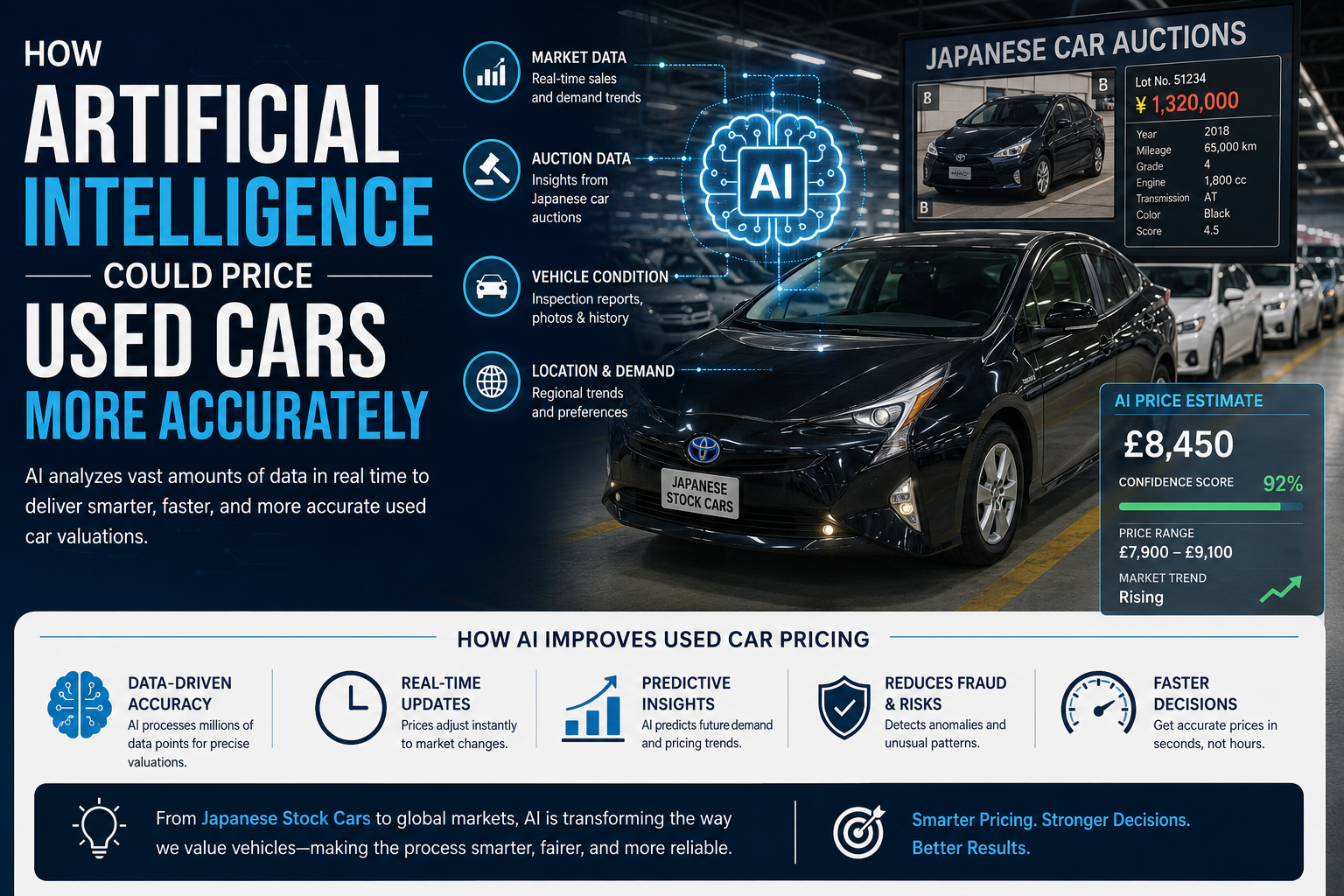
The used car market has always relied on a combination of experience, historical data, and market intuition to determine vehicle values. While these methods have served buyers and sellers for decades, they often struggle to keep pace with rapidly changing market conditions. Fluctuating demand, regional preferences, fuel prices, seasonal buying trends, and vehicle condition all influence pricing, making accurate valuations increasingly complex.
Artificial intelligence (AI) is transforming this landscape by analyzing enormous datasets in real time. Instead of relying on generalized estimates, AI-driven systems can generate highly precise valuations based on thousands of variables. This technological evolution is particularly relevant for businesses dealing with Japanese Stock Cars, where pricing accuracy plays a vital role in international trade and customer confidence.
Why Traditional Used Car Pricing Has Limitations
Conventional valuation methods typically use historical sales records, mileage, vehicle age, and overall condition as primary indicators. Although these factors remain important, they often fail to capture sudden market shifts.
For example, a vehicle model may become more desirable because of rising fuel prices or changes in import regulations. Likewise, supply shortages can increase resale values within weeks. Manual pricing methods rarely respond to these developments quickly enough, leading to overpricing or undervaluation.
Human judgment also introduces inconsistencies. Two inspectors may evaluate the same vehicle differently, creating variations in estimated value. AI minimizes these discrepancies by applying standardized analytical models across every assessment.
The Role of Artificial Intelligence in Vehicle Valuation
Artificial intelligence processes vast quantities of structured and unstructured information far beyond human capability. Modern machine learning algorithms continuously evaluate new sales transactions, market demand, depreciation trends, and consumer behavior.
Instead of assigning a fixed value based solely on age or mileage, AI predicts what buyers are actually willing to pay at a specific moment.
This dynamic approach enables pricing models to adapt continuously as fresh information becomes available. As a result, dealerships, exporters, insurers, and consumers gain access to valuations that reflect current market realities rather than outdated averages.
Massive Data Creates Better Predictions
One of AI's greatest strengths lies in its ability to combine countless data sources into a single pricing model.
These sources may include:
- Previous vehicle sale prices
- Mileage records
- Service history
- Accident reports
- Auction performance
- Geographic demand
- Seasonal buying trends
- Fuel economy
- Brand reputation
- Parts availability
- Economic indicators
- Import regulations
By examining relationships among these variables, AI identifies pricing patterns that would remain hidden through traditional analysis.
For businesses specializing in Japanese Stock Cars, this capability provides far greater confidence when purchasing inventory for export markets.
Learning from Japanese Car Auctions
Among the richest sources of vehicle pricing data are Japanese car auctions. Every day, thousands of vehicles pass through these auctions, generating an enormous amount of information regarding condition, specifications, mileage, inspection grades, and final selling prices.
AI systems can process this auction data to understand how individual characteristics influence market value.
For instance, two vehicles with identical production years may sell at significantly different prices because one has superior maintenance records, optional factory equipment, or stronger buyer demand in overseas markets.
The continuous flow of information from Japanese car auctions allows AI models to remain remarkably current while improving prediction accuracy over time.
Understanding Vehicle Condition Beyond Mileage
Mileage alone no longer defines a vehicle's worth.
Artificial intelligence evaluates numerous condition indicators simultaneously, including:
- Exterior damage
- Interior wear
- Mechanical inspection reports
- Paint quality
- Tire condition
- Previous repairs
- Corrosion risk
- Maintenance consistency
Advanced computer vision technology can even analyze vehicle photographs to identify scratches, dents, paint imperfections, and body alignment issues.
This objective evaluation reduces subjectivity while creating more accurate pricing recommendations.
Predicting Market Demand Before Prices Change
AI does more than analyze the present—it anticipates future trends.
Machine learning models detect emerging demand by monitoring search behavior, dealership inventories, economic indicators, social trends, and consumer purchasing patterns.
If hybrid vehicles suddenly become more desirable because of rising fuel costs, AI identifies this trend before traditional valuation guides update their pricing.
Likewise, if export demand increases for certain Japanese Stock Cars in overseas markets, pricing models can adjust accordingly.
Predictive intelligence enables businesses to make purchasing decisions before competitors recognize market shifts.
Regional Pricing Becomes More Accurate
Vehicle values often differ dramatically between countries and even between cities.
A compact fuel-efficient car may command premium prices in densely populated urban centers, while larger SUVs remain more desirable in rural regions.
Artificial intelligence recognizes these geographic preferences by analyzing localized transaction data.
For exporters, this represents a significant advantage. Instead of assigning one universal price, AI recommends values based on the destination market, increasing both profitability and competitiveness.
Reducing Pricing Bias
Human appraisals naturally involve personal judgment and experience. Even skilled professionals may unintentionally introduce inconsistencies into the valuation process.
AI applies identical evaluation criteria across every vehicle, improving fairness and consistency.
Standardized algorithms also reduce emotional pricing decisions, helping dealers avoid overpaying for inventory or undervaluing desirable models.
Although human expertise remains valuable, combining professional inspections with AI-generated insights often produces the most reliable results.
Faster Decisions for Buyers and Dealers
Traditional appraisals can require lengthy inspections, paperwork, and manual research.
Artificial intelligence accelerates the entire process.
Within seconds, AI platforms can compare a vehicle against thousands of similar listings, recent transactions, auction outcomes, and depreciation models.
Dealerships benefit from quicker inventory turnover, while buyers receive transparent pricing supported by extensive market analysis.
This efficiency becomes especially valuable when evaluating large inventories of Japanese Stock Cars imported from multiple suppliers.
Supporting Insurance and Financing
Accurate vehicle valuation extends well beyond buying and selling.
Insurance companies depend on reliable market values when calculating premiums or settling claims. Financial institutions require realistic valuations before approving vehicle loans.
Artificial intelligence provides both industries with current, evidence-based pricing supported by continuously updated market information.
This reduces disputes while improving confidence among lenders, insurers, dealerships, and consumers alike.
Detecting Pricing Anomalies and Fraud
AI excels at identifying unusual pricing behavior.
If a vehicle's asking price differs significantly from comparable models, machine learning systems immediately flag the discrepancy for further review.
Similarly, AI can detect suspicious mileage inconsistencies, manipulated service histories, or repeated resale patterns associated with fraudulent activity.
When combined with inspection reports from Japanese car auctions, these analytical tools strengthen trust throughout the used vehicle marketplace.
Continuous Improvement Through Machine Learning
Unlike traditional valuation guides that receive periodic updates, AI systems improve continuously.
Every completed transaction becomes new learning material.
As additional sales occur across global markets, machine learning algorithms refine their predictions, adapting to changing consumer preferences, economic conditions, and evolving vehicle technologies.
This self-improving capability ensures that pricing models become increasingly accurate over time rather than remaining static.
Challenges That Still Exist
Despite its impressive capabilities, artificial intelligence is not infallible.
Incomplete maintenance records, inaccurate inspection reports, sudden regulatory changes, and unexpected economic events can influence pricing accuracy.
Rare collector vehicles or highly customized automobiles may also present challenges because limited historical data exists for comparison.
For this reason, many industry professionals combine AI-generated valuations with experienced human judgment to achieve the most balanced assessments.
The Future of AI in Used Car Pricing
Artificial intelligence is steadily reshaping how the automotive industry values pre-owned vehicles. As data quality improves and machine learning models become increasingly sophisticated, pricing will become even more transparent, responsive, and dependable.
Businesses dealing with Japanese Stock Cars stand to benefit significantly from these innovations, particularly when sourcing vehicles through Japanese car auctions. Real-time analytics, predictive modeling, and standardized evaluations help reduce uncertainty while improving purchasing decisions across domestic and international markets.
As AI continues to evolve, accurate vehicle pricing will no longer depend primarily on estimation or intuition. Instead, it will be driven by intelligent systems capable of interpreting vast amounts of market information with remarkable speed and precision, creating a more efficient and trustworthy used car marketplace for everyone involved.
Share On :
Tweet | LinkedIn | |