Latest Updates Click Here


CFE Certification Guide 2026: Exam, Cost, Salary & Career Path
Learn everything about the Certified Fraud Examiner (CFE) certification in 2026, including the updated exam, eligibility, cost, salary, career opportunities, and preparation tips.
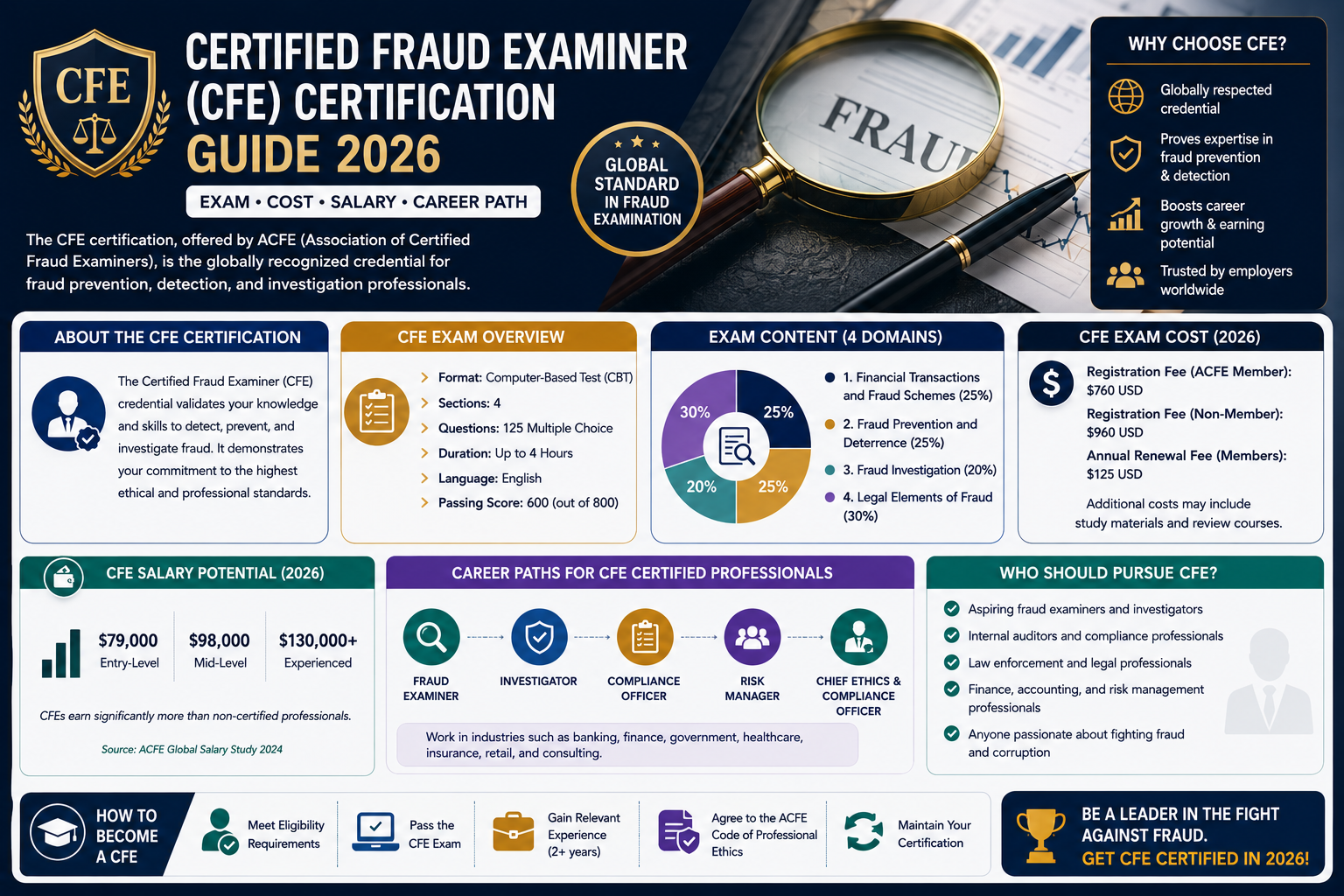
Financial fraud continues to be one of the biggest challenges facing organizations, governments, banks, insurance companies, and multinational corporations. From financial statement manipulation to cyber-enabled fraud and money laundering, businesses need professionals who can detect suspicious activities, investigate financial crimes, and strengthen internal controls. This growing demand has made the Certified Fraud Examiner (CFE) credential one of the world's most respected certifications in fraud prevention and investigation.
Offered by the Association of Certified Fraud Examiners (ACFE), the CFE certification validates expertise across fraud detection, financial investigations, legal issues, and fraud prevention. It is recognized globally by employers seeking professionals capable of protecting organizations from financial and occupational fraud.
If you're considering becoming a Certified Fraud Examiner in 2026, this guide explains the latest exam structure, eligibility, costs, career opportunities, salary expectations, and preparation strategies.
What Is the Certified Fraud Examiner (CFE) Certification?
The Certified Fraud Examiner (CFE) is a globally recognized professional credential for specialists involved in preventing, detecting, investigating, and deterring fraud. Unlike certifications focused solely on accounting or auditing, the CFE combines knowledge from accounting, criminology, law, investigation techniques, ethics, and risk management.
Professionals holding the CFE credential often work with:
-
Internal audit teams
-
Corporate compliance departments
-
Financial institutions
-
Government agencies
-
Law enforcement
-
Consulting firms
-
Insurance companies
-
Forensic accounting teams
Because fraud risks continue to evolve alongside digital transformation, organizations increasingly value professionals with specialized anti-fraud expertise.
CFE Exam Structure in 2026
The ACFE introduced an updated CFE exam structure on June 2, 2026, following its latest Job Task Analysis. The new exam now consists of three sections instead of the previous four-section format, ensuring closer alignment with modern fraud examination responsibilities.
|
Exam Section |
Topics Covered |
|
Fraud Schemes and Financial Crimes |
Occupational fraud, financial statement fraud, corruption, asset misappropriation, financial crimes |
|
Fraud Investigations and Legal Issues |
Investigation planning, interviewing, evidence collection, legal procedures, reporting |
|
Fraud Prevention and Deterrence |
Internal controls, ethics, governance, fraud risk management, compliance, prevention strategies |
The updated blueprint emphasizes practical workplace knowledge and real-world fraud investigation skills rather than memorization.
Eligibility Requirements
Before earning the CFE credential, candidates must satisfy ACFE's eligibility requirements.
Generally, applicants should:
-
Become an ACFE member.
-
Meet the required eligibility point threshold based on education, professional experience, and certifications.
-
Demonstrate relevant fraud-related experience.
-
Agree to the ACFE Code of Professional Ethics.
-
Successfully pass all required exam sections.
Because eligibility is evaluated through a points-based system, professionals from accounting, auditing, compliance, banking, law enforcement, investigation, and legal backgrounds may all qualify.
How Much Does the CFE Certification Cost?
The total investment depends on your membership status and study resources.
The CFE Exam Application fee is USD $480, which includes application processing and the first attempt for each required exam section. Candidates who do not pass a section may retake it for an additional fee. Membership fees, optional preparation courses, and study materials are separate expenses.
When planning your budget, consider:
-
ACFE membership
-
Exam application fee
-
Study materials
-
Optional review course
-
Continuing professional education after certification
Although the certification requires an investment, many employers sponsor the credential because of its relevance to fraud prevention and compliance programs.
Career Opportunities After Earning the CFE
The CFE credential opens doors across public and private sectors where fraud risk management is a priority.
Popular career paths include:
-
Fraud Examiner
-
Forensic Accountant
-
Internal Auditor
-
Compliance Officer
-
Anti-Money Laundering (AML) Analyst
-
Risk Management Specialist
-
Corporate Investigator
-
Financial Crimes Investigator
-
Government Auditor
-
Fraud Risk Consultant
Financial institutions, multinational corporations, healthcare organizations, insurance companies, and government agencies frequently seek professionals with fraud investigation expertise.
CFE Salary Expectations
Salary varies depending on experience, country, industry, and job role.
Professionals with the CFE credential often earn competitive salaries because fraud investigation requires specialized knowledge that combines accounting, auditing, investigative techniques, and legal understanding. Senior professionals working in forensic accounting, financial crime investigations, enterprise risk management, and consulting generally command higher compensation than entry-level analysts.
Beyond salary, the certification can improve promotion opportunities, expand consulting prospects, and strengthen professional credibility within compliance and governance teams.
Is the CFE Certification Worth It?
For professionals interested in fraud examination, forensic accounting, investigations, compliance, or financial crime prevention, the answer is generally yes.
The certification provides several long-term advantages:
-
Global professional recognition.
-
Specialized anti-fraud expertise.
-
Strong career mobility.
-
Access to ACFE resources and community.
-
Improved professional credibility.
It is particularly valuable for accountants, auditors, investigators, compliance specialists, law enforcement professionals, and risk managers seeking to specialize in fraud-related roles.
How to Prepare for the CFE Exam
Effective preparation involves more than reading study notes. Candidates should understand fraud concepts and learn how they apply in practical investigations.
A balanced preparation plan should include:
-
Reviewing the official CFE Exam Content Outline.
-
Studying the Fraud Examiners Manual.
-
Completing practice questions.
-
Reviewing case studies.
-
Understanding investigation procedures.
-
Practicing scenario-based decision making.
Many recent candidates also recommend using the official ACFE preparation resources because they closely reflect the exam's structure and learning objectives.
Many learners also reinforce their preparation using updated practice questions, realistic exam simulators, and structured revision resources available on this website certmage.com, while relying on the official ACFE content outline, Fraud Examiners Manual, and practical fraud investigation knowledge as the primary foundation of their studies.
Conclusion
The Certified Fraud Examiner (CFE) certification remains one of the most respected credentials for professionals working in fraud prevention, financial investigations, forensic accounting, and compliance. With the updated three-section exam introduced in 2026, the certification better reflects today's anti-fraud responsibilities and real-world investigative practices.
If you're looking to specialize in detecting financial crime, protecting organizations from fraud, and advancing your career in compliance or forensic investigations, earning the CFE credential can be a valuable long-term investment in your professional development.
FAQs
Is the CFE exam difficult?
The CFE exam requires strong knowledge of fraud schemes, investigations, legal issues, and prevention strategies. Candidates with relevant professional experience and structured preparation generally find the exam manageable.
How much does the CFE exam cost in 2026?
The ACFE charges a USD $480 CFE Exam Application fee, which includes application processing and the first attempt for each required exam section. Additional membership and preparation costs apply.
Who should pursue the CFE certification?
The certification is ideal for auditors, accountants, investigators, compliance professionals, AML specialists, law enforcement officers, forensic accountants, and risk management professionals seeking fraud-related careers.
Is the CFE certification recognized internationally?
Yes. The Certified Fraud Examiner credential is recognized globally and is widely respected across government agencies, financial institutions, multinational corporations, consulting firms, and regulatory organizations.
What is the best way to prepare for the CFE exam?
Study the official ACFE content outline, review the Fraud Examiners Manual, practice scenario-based questions, understand investigation techniques, and reinforce learning through realistic practice assessments.
Learn More: Are Updated Exam Dumps PDF Worth It? Pros, Cons, and Best Practices
Share On :
Tweet | LinkedIn | |