Latest Updates Click Here


Convenience Store or Vape Shop? Picking the Right Franchise in 2026
Compare convenience store vs. vape shop franchises in 2026. Explore startup costs, profits, regulations, and investment insights to choose the right business.
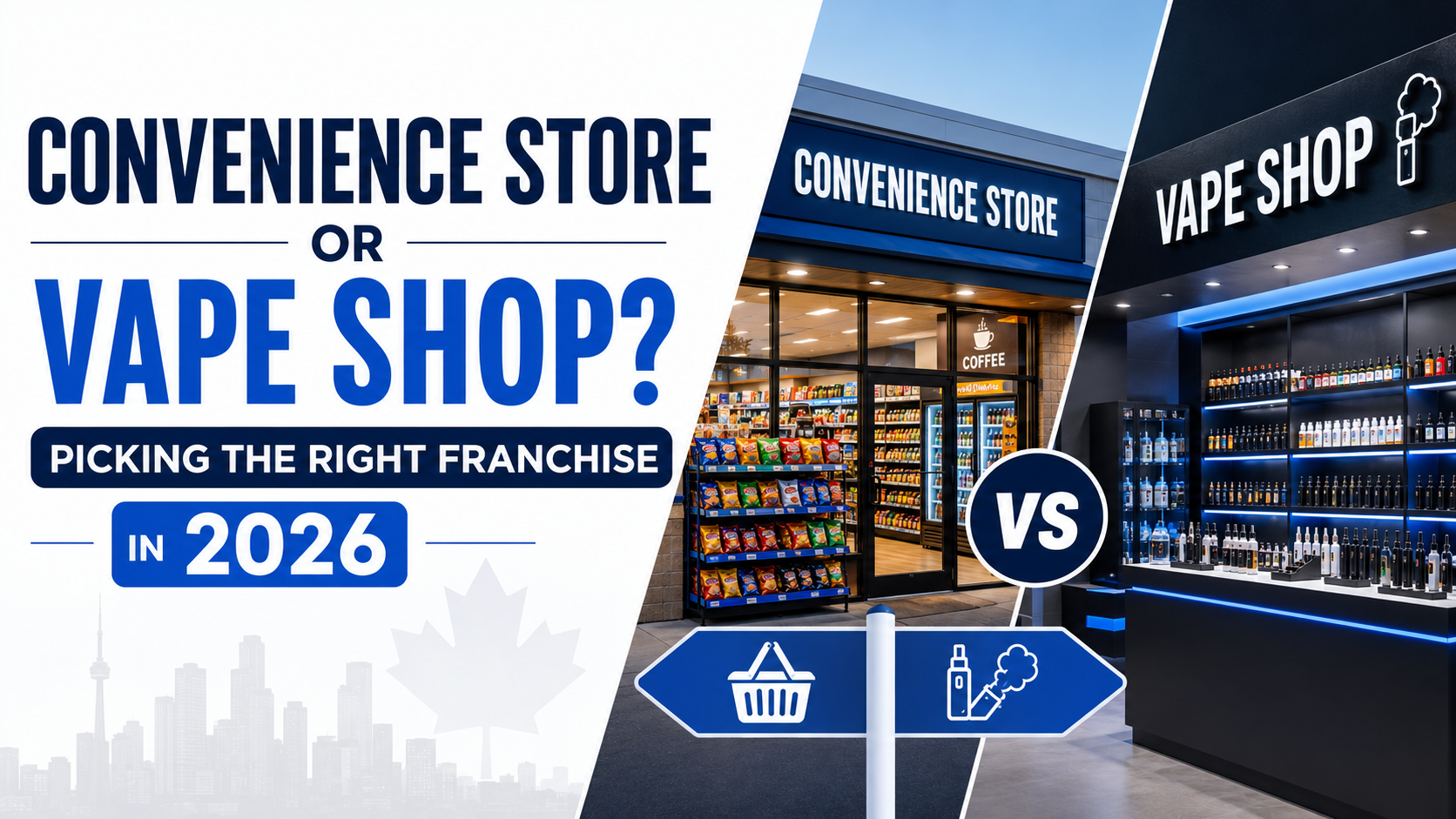
Two entrepreneurs walk into a franchise expo with the same $80,000 budget. One walks out having signed with a convenience store chain. The other signs with a vape shop brand. Both made a smart choice, just not the same one, and not for the same reasons.
That's really the heart of the convenience store vs vape shop franchise decision. It's not about which industry sounds more exciting. It's about how much daily complexity you want to manage, how patient you can afford to be with cash flow, and how comfortable you are keeping up with rules that change more often than you'd expect. This guide walks through both options honestly real numbers, real regulations, and a clear-eyed look at who each one actually suits. If you're comparing a convenience store franchise or a vape shop franchise as your first business, everything you need to make that call is below.
Two Very Different Businesses, One Big Decision
Before you look at numbers, it helps to understand what you're actually signing up for with each one.
The Convenience Store: Steady, Familiar, Broad
A convenience store sells a little bit of everything: milk, snacks, drinks, tobacco, lottery tickets, sometimes fuel. That variety is the whole point. People need these things no matter what's happening in the economy, which is why the business tends to hold up well even in slow years.
The numbers back this up. The Canadian Convenience Stores Association says there are over 26,000 of these stores across the country, employing more than 227,000 people and serving about 10 million customers a day. According to IBISWorld, the industry was worth $11.3 billion in 2025. Fewer individual stores are opening these days, but the total market hasn't shrunk. Bigger chains are simply absorbing more of the business.
When you buy into a convenience store franchise, you're usually getting more than a storefront. You get supplier deals already in place, point-of-sale software, staff training, and marketing help most of it baked into your franchise fee. Infinity Mart, for example, runs two formats under one brand: standalone convenience stores and full-service locations paired with branded gas stations through partners like Mobil, Esso, and Ultramar, with franchise opportunities currently open across Ontario, Alberta, British Columbia, Manitoba, Quebec, Nova Scotia, PEI, and Newfoundland & Labrador. It's also a good illustration of how the product mix keeps expanding. Ontario's convenience stores began selling beer and wine in recent years, giving owners another revenue line on top of the usual snacks, grocery staples, and lottery sales.
The Vape Shop: Smaller, Sharper, Riskier
A vape shop is the opposite kind of business. You're not selling a bit of everything, you're selling one category, deeply. Devices, e-liquids, accessories. Your customers tend to be loyal and knowledgeable, and they come back often.
Canada's vaping market is real, if modest: recent estimates put it around USD $1.3–1.4 billion, built on roughly 2 million adult vapers across the country, with steady growth year over year. The upside here is that you tend to make more on each sale than a convenience store does. The catch is that your whole business rests on one product line, and that product line sits inside one of the strictest, fastest-moving parts of Canadian retail law. More on that shortly.
Interestingly, some franchisors now offer both models under one roof. Infinity Vape, the specialty vape retail arm of Infinity Mart, is one example of a growing vape shop franchise placed in premium locations across Canada, with investment starting as low as $39,000 plus inventory. That's meaningfully below the general CAD $50,000–$150,000 range cited above, which makes it worth a look for anyone specifically hunting for a lower-entry vape franchise.
What Each One Actually Costs to Open
Convenience Stores: A Wide Range, Often Bigger
Costs swing a lot depending on whether the location includes fuel service. A standalone store without gas pumps is far cheaper to open than one that does. Beyond the franchise fee, you're paying for renovations, signage, equipment, and starting inventory and once fuel infrastructure enters the picture, total investment often climbs into six figures. The upside: many established brands offer financing help or supplier credit, which takes some of the pressure off your upfront cash.
Vape Shops: A Tighter, More Predictable Number
The vape shop startup cost Canada entrepreneurs typically face runs between about CAD $50,000 and $150,000, covering renovations, licensing, point-of-sale systems, opening inventory, and a cash reserve. That last piece matters more than most new owners expect. It can take twelve to twenty-four months for a vape shop to hit steady revenue, and owners who open with no financial cushion tend to struggle a lot more than those who open with a leaner budget but six solid months of runway behind them.
Side-by-Side: The Numbers That Matter
|
What You're Comparing |
Convenience Store |
Vape Shop |
|
Typical startup cost |
Franchise fee + build-out; six figures common with fuel |
Roughly CAD $50,000–$150,000 |
|
What you're selling |
A little of everything — groceries, drinks, tobacco, fuel |
One category, done well — devices, e-liquids, accessories |
|
Margins |
Smaller per item, higher volume |
Bigger per item, lower volume |
|
Rules to follow |
Established, well-understood |
Fast-changing (see Ontario's Smoke-Free Ontario Act) |
|
Time to steady income |
Usually quicker |
Often 12–24 months |
|
Good fit for |
Owners who want stability and an easy staff hand-off |
Owners with real interest in the category, comfortable with compliance work |
The Rules You'll Actually Have to Follow
This is where the two paths pull apart the most, and where it pays to slow down and pay attention.
Convenience Stores Keep It Simple
Yes, there are rules checking ID for tobacco and lottery sales, food safety standards, local licensing but none of it changes overnight. Franchisors in this space have been dealing with the same regulatory playbook for years, and industry groups like the Canadian Convenience Stores Association help members stay on top of it.
Vape Shops in Ontario: Read This Part Twice
Running a vape retail business Ontario-wide means playing by some of the tightest retail rules in the province. Under the Smoke-Free Ontario Act, 2017, any store that isn't a registered specialty vape shop can't sell vapour products above 20 mg/mL of nicotine. To count as a specialty vape store, at least 85% of your sales have to come from vaping products and even then, your displays and promotions can't be visible from outside the store. Age rules are stricter here too: 19 to buy in Ontario, versus 18 under federal law. On top of that, the Tobacco and Vaping Products Act adds its own layer of nicotine limits, child-resistant packaging, restrictions on ads that could appeal to youth and Health Canada now requires vape companies to report their sales twice a year.
None of this should scare you off. It just means you need to treat compliance as part of the job, not a one-time task. Order stock before your registration comes through, or get a display rule wrong, and you're looking at fines or seized inventory, the kind of mistake that's expensive to make twice.
One Rule That Applies to Both
No matter which one you choose, Canadian franchise law protects you before you sign. Seven provinces Ontario, BC, Alberta, Manitoba, New Brunswick, PEI, and Saskatchewan starting June 30, 2026 require franchisors to hand over a Franchise Disclosure Document at least 14 days before you sign anything or pay a cent. In Ontario, this comes from the Arthur Wishart Act. Read the whole thing, not just the highlights, this applies whether you're eyeing a c-store banner or a vape brand.
Which One Makes More Money?
Vape shops usually win on margin devices and e-liquids carry a bigger markup than a bag of chips. A well-run shop with a loyal customer base can post solid annual profit once it finds its footing. Convenience stores win on smaller margins, but a steady stream of transactions all day, every day, from fuel, snacks, and everyday essentials. Put simply: a vape shop can earn more per sale, while a convenience store earns more predictably each month.
Picture This
Two new franchisees open on the same day with similar budgets. One opens a convenience store in a residential area. Sales are small and constant coffee, a snack, a lottery ticket and the store hits a predictable monthly rhythm within a few months, because the neighbourhood was already shopping there for everyday needs. The other opens a vape shop on a busy commercial strip. The first several months are slower, since the shop has to build its customer base almost from scratch. But by month eighteen, once regulars are coming back, each visit is worth more than a comparable visit to the convenience store. Neither owner made the wrong call; they just picked different trade-offs.
Looking for a Low-Cost Way In?
If you're browsing low investment franchise ideas Canada has to offer, convenience stores are usually the easier on-ramp. You get a broader income base to ride out slow months, supplier relationships already built, and franchisor support that's had years to get refined. Vape shops can be affordable too; some brands even waive their franchise fee, and Infinity Vape's roughly $39,000-plus-inventory entry point is a real-world example of that lower bar but a smaller product focus paired with heavier compliance work means "low investment" doesn't always mean "low effort."
So, Which One Is Right for You?
There's no single correct answer, just the one that fits how you want to run a business.
A Convenience Store Might Suit You If...
-
You'd rather serve everyone in the neighbourhood than a niche group
-
You want rules that don't shift under your feet every year
-
You're planning to eventually step back and let staff run day-to-day
-
Predictable monthly income matters more to you than bigger margins
A Vape Shop Might Suit You If...
-
You're genuinely interested in the category, not just the numbers
-
You don't mind keeping an eye on regulatory updates as part of the job
-
You'd rather have fewer, higher-value sales than constant foot traffic
-
Building a brand people feel loyal to appeals to you more than running a general store
Before You Sign Anything, Check This List
Whichever path you're leaning toward, work through this before any money changes hands:
-
Read the entire Franchise Disclosure Document not the summary at least 14 days before signing
-
Get the franchise fee, royalties, and marketing fund contributions confirmed in writing
-
Talk to at least three current franchisees yourself don't rely on the ones the franchisor picks for you
-
Check zoning rules, and for vape shops, confirm specialty-store registration with your local public health unit
-
Set aside 6–12 months of operating costs as a cash reserve, beyond your opening budget
-
Have a franchise lawyer look over the disclosure document and lease before you sign
-
Ask about "approved supplier" restrictions and what inventory you're required to buy
A well-run franchisor should be able to walk you through each of these steps clearly. Infinity Mart, for instance, lays out its process in nine stages from an initial interest submission and discovery call, through due diligence, site selection, agreement signing, training, store buildout, and grand-opening support, right through to ongoing operations. That kind of structured path is a reasonable benchmark to compare other franchisors against.
The Bottom Line
When you weigh a convenience store vs vape shop franchise, convenience stores tend to be the smoother ride for a first-time owner with steadier income, more established support, fewer regulatory curveballs. Vape shops can absolutely pay off, and often pay off well, but they ask more of you upfront: patience while the customer base builds, and ongoing attention to rules that keep changing. Whichever way you learn, read the disclosure document properly, talk to people already running one, and be honest with yourself about how much cash you'll need to get through year one. That homework matters more than which industry you pick.
One more thing worth knowing: you don't necessarily have to pick a franchisor based on which model you land on. Infinity Mart operates both its convenience store banner and its Infinity Vape arm so whichever direction this guide points you toward, it's worth a direct conversation with a franchisor who can walk you through the real numbers for your market, your budget, and the specific location you have in mind.
Share On :
Tweet | LinkedIn | |