Latest Updates Click Here


How Online Prediction Market Platforms Are Challenging the Sportsbook
Prediction markets use crowd-driven pricing to forecast outcomes, while sportsbooks set fixed odds. This shift brings real-time trading, AI insights, and challenges traditional betting models.
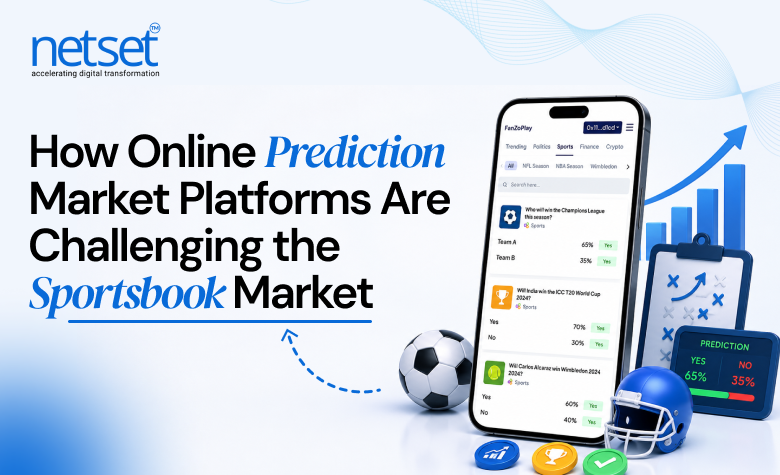
Online prediction market platforms are gradually reshaping how people interpret outcomes of sports and real-world events, and in some cases, they are beginning to challenge the dominance of traditional sportsbook models. While sportsbooks have long relied on fixed odds and house-controlled margins, prediction markets introduce a more dynamic, crowd-driven pricing system where probabilities are shaped by collective intelligence rather than a single operator’s bookmaking structure.
The shift from sportsbooks to prediction-driven models
Traditional sportsbooks operate on a simple principle: set odds, balance books, and profit from the margin (or “vig”). This model has scaled into a massive global industry. According to multiple industry estimates, the global online gambling and sports betting market is valued at over $100 billion and continues to grow steadily, especially after widespread legalization in regions like the United States. In the U.S. alone, annual sports betting handle has crossed $120 billion in recent years, reflecting rapid consumer adoption.
Prediction markets, on the other hand, function more like financial exchanges. Users buy and sell contracts based on the probability of an event occurring—such as a team winning a championship or a player scoring above a threshold. Prices fluctuate based on real-time sentiment and information flow, often making these platforms resemble decentralized forecasting engines rather than betting platforms.
This structural difference is what makes them increasingly disruptive to sportsbooks.
Why prediction markets are gaining attention
One of the key reasons prediction markets are challenging sportsbooks is the efficiency of information. In sportsbooks, odds are adjusted by operators who interpret data, public betting behavior, and risk exposure. In prediction markets, however, pricing is determined directly by participants. This can result in more accurate probability signals, especially when informed traders participate.
Research from academic studies on platforms like political prediction markets has shown that crowd-based forecasting can outperform expert polls in certain scenarios, sometimes achieving accuracy improvements of 10–20% depending on event type and liquidity conditions.
This accuracy advantage is now extending into sports forecasting ecosystems, where users treat outcomes as tradable assets rather than pure wagers.
Real-time pricing and behavioral shift
Unlike sportsbooks that lock odds once a bet is placed, prediction markets continuously update pricing until an event resolves. This creates a financial-market-like environment where participants react to breaking news instantly—injuries, lineup changes, weather updates, and even social media sentiment shifts.
This dynamic behavior is especially attractive to younger users who are already familiar with trading apps, crypto exchanges, and stock market interfaces. Instead of “betting against the house,” users are essentially trading against each other, which changes the psychological experience of risk-taking.
Recent surveys across fintech and betting behavior trends suggest that nearly 40% of Gen Z users prefer platforms with trading-like interfaces over traditional betting dashboards, signaling a shift in user expectations.
Impact of AI and data intelligence
Artificial intelligence is playing a major role in accelerating prediction market adoption. Machine learning models are increasingly used to analyze historical sports data, real-time performance metrics, and even sentiment extracted from social media platforms.
These systems help refine probability curves, detect anomalies in pricing, and reduce inefficiencies that sportsbooks traditionally exploit. AI-driven forecasting tools can also identify early market signals, which makes prediction platforms more responsive than conventional odds-setting systems.
Companies across the fintech and sports analytics ecosystem, including firms like NetSet Software, are exploring advanced systems that combine real-time analytics with scalable trading infrastructure. This has also encouraged the rise of specialized solutions such as prediction market platform white-label prediction market software, enabling faster deployment of market-ready forecasting systems.
Changing economics of sports forecasting
Another reason prediction markets are disrupting sportsbooks is their different revenue structure. Sportsbooks rely heavily on margin-based profits, typically ranging between 4% and 10% per market depending on competition and jurisdiction. Prediction markets instead often depend on transaction fees or liquidity-based spreads, which can scale differently depending on user activity.
This difference reduces the “house advantage” perception and makes prediction markets appear more transparent. Transparency is becoming a major factor in user trust, especially in an era where consumers are increasingly skeptical of opaque algorithmic odds.
Regulatory challenges and limitations
Despite their growth, prediction markets still face significant regulatory uncertainty. In many jurisdictions, they exist in a grey area between financial instruments and gambling products. Sportsbooks, on the other hand, are more clearly regulated in regions where betting laws are established.
Regulators are particularly cautious because prediction markets can resemble speculative trading, raising concerns about manipulation, insider information, and market integrity. This has slowed down mainstream adoption in certain regions, even as technology continues to mature.
Liquidity is another challenge. Unlike sportsbooks that can centrally manage risk, prediction markets rely on sufficient participation to ensure stable pricing. Low-liquidity markets can lead to volatility and less reliable forecasting accuracy.
The future convergence of betting and financial markets
The long-term trend suggests that the boundaries between sportsbooks, prediction markets, and financial trading platforms may continue to blur. Sports outcomes, political events, and even entertainment results are increasingly being treated as data-driven tradable assets.
Industry forecasts indicate that the prediction market segment could grow at a double-digit CAGR over the next five years, driven by advancements in blockchain infrastructure, AI analytics, and mobile-first trading interfaces.
As user expectations evolve, sportsbooks may need to incorporate more dynamic pricing models and real-time data integration to remain competitive. Meanwhile, prediction markets will likely continue refining their liquidity systems, regulatory frameworks, and user experience models.
Conclusion
Online prediction market platforms are not replacing sportsbooks outright, but they are fundamentally challenging how odds, probability, and engagement are defined in the digital era. By leveraging crowd intelligence, real-time data, and AI-driven insights, these platforms introduce a more transparent and interactive approach to forecasting outcomes.
As technology continues to evolve, the gap between betting and prediction markets will likely continue to narrow, creating a hybrid ecosystem where information, probability, and trading behavior intersect in increasingly sophisticated ways.
FAQ –
1. What is the main difference between prediction markets and sportsbooks?
Sportsbooks set fixed odds and earn profit through a built-in margin, while prediction markets allow users to trade contracts where prices change dynamically based on collective market activity and real-time information.
2. Are prediction markets more accurate than sportsbooks?
In many cases, prediction markets can be more accurate because they aggregate crowd intelligence. Academic studies on forecasting platforms show that crowd-based models can outperform expert predictions by 10–20% in certain scenarios, depending on liquidity and participation levels.
3. Why are prediction markets becoming popular among users?
They are gaining popularity due to real-time pricing, transparency, and a trading-style interface. Many users—especially younger audiences familiar with fintech apps—prefer markets that behave like financial exchanges rather than traditional betting systems.
4. How does AI impact prediction market platforms?
AI enhances prediction markets by analyzing large datasets, detecting trends, and improving probability accuracy. Machine learning models also help identify inefficiencies and improve real-time forecasting, making the platforms more responsive and data-driven.
5. What challenges do prediction markets face today?
The biggest challenges include regulatory uncertainty, liquidity issues, and concerns about market manipulation. In some regions, they fall into a grey area between gambling and financial trading, which slows mainstream adoption.
Share On :
Tweet | LinkedIn | |