Latest Updates Click Here


The Complete Crypto Exchange Development Process for Beginners
A simplified breakdown of the crypto exchange development process, from pre-development planning through launch. Covers choosing your exchange type (CEX, DEX, or hybrid), building core features, and layering in security the right way. A quick, practical read for founders planning their own exchange build in 2026.
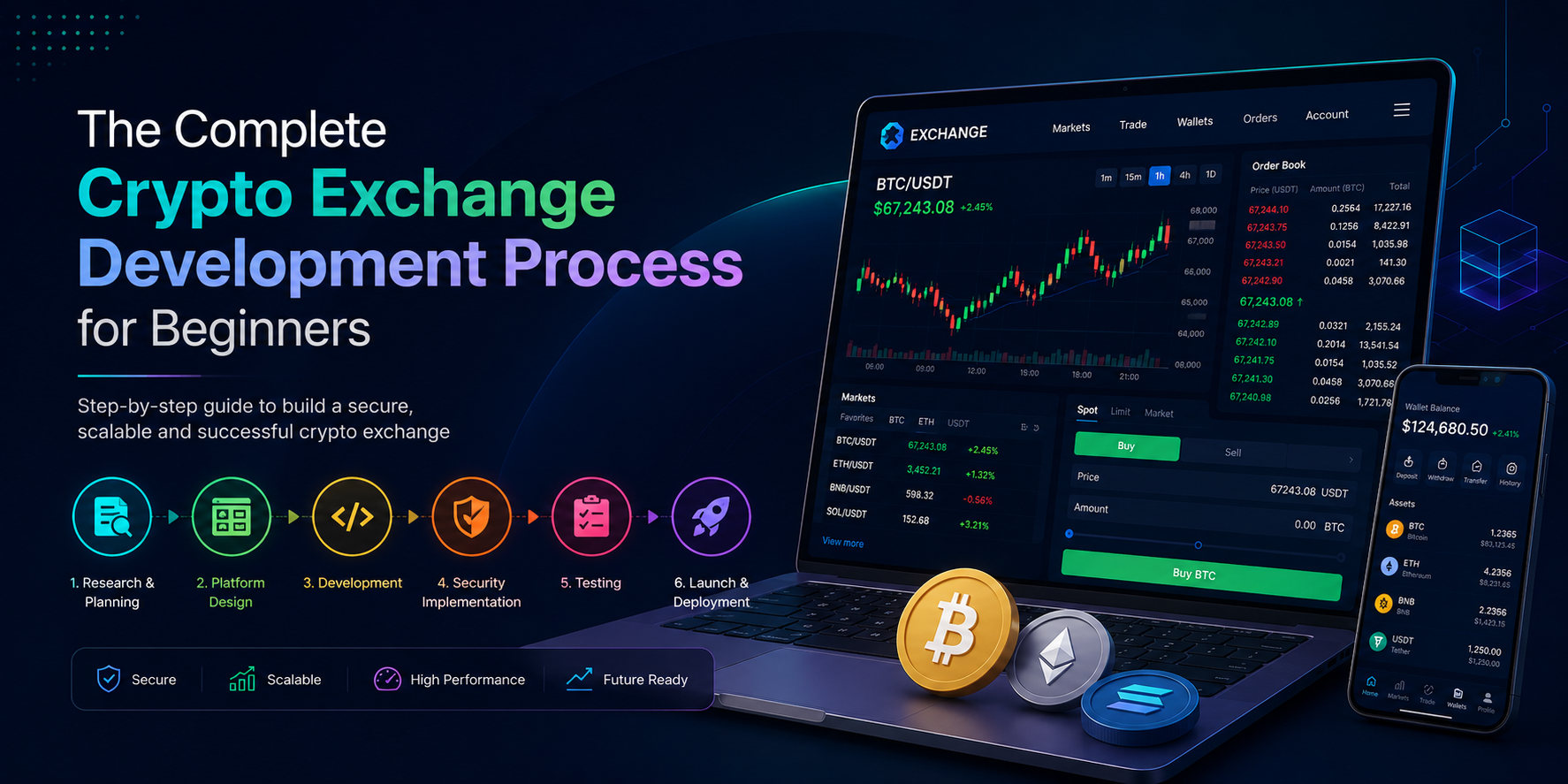
Crypto exchange development is one of the most rewarding but demanding projects a founder can take on in 2026. It touches business strategy, software architecture, security, and regulatory compliance all at once. Getting the process right from the start is what separates exchanges that scale smoothly from ones that need a costly rebuild within their first year.
This blog breaks the entire journey into two parts: what happens before development starts, and the actual build process itself.
What Is Crypto Exchange Development?
At its core, crypto exchange development means building a platform where users can buy, sell, and trade digital assets. Behind the interface, an order matching engine pairs buy and sell orders in real time, wallets hold and move user funds, and the underlying architecture needs to stay fast and stable even during high trading volume.
Why Build a Crypto Exchange in 2026?
Trading volume keeps climbing, but more importantly, the market has fragmented. Instead of a handful of dominant platforms, there's growing demand for exchanges built around specific regions, asset types, or trading communities. That gap is exactly where new founders find real opportunity.
How a Crypto Exchange Actually Works
When a user places an order, the matching engine checks the order book for a compatible counter-order based on price and timing. Once matched, the trade executes, balances update through wallet integration, and the order book refreshes instantly. This entire sequence needs to hold up under pressure, especially during volatile market swings.
Choosing Your Exchange Type
Centralized Exchange (CEX): Full control over the trading experience and custody, paired with heavier compliance responsibility.
Decentralized Exchange (DEX): Smart contracts handle trade execution, users keep custody of their own funds, and audits become critical to prevent exploits.
Hybrid Exchange: Blends centralized speed with decentralized transparency, appealing to users who want both performance and self-custody.
This decision needs to happen early, since it shapes your technology stack, your compliance obligations, and your development timeline.
Pre-Development Planning: The Stage Founders Skip Too Often
Before any development work begins, four things need to be locked down.
Define your business goals. Are you building a general-purpose exchange, or targeting a specific niche like regional traders or a particular asset class? Vague goals lead to feature creep and blown timelines.
Choose a revenue model. Trading fees, listing fees, and subscription tiers are the most common paths, and your choice affects both your pricing structure and your platform's incentive design.
Identify your target audience. Retail traders, institutional players, and niche communities all expect different things from an exchange, from interface complexity to available trading pairs.
Research legal and compliance requirements. Licensing rules vary significantly by region, and this research needs to happen before development, not after you've already built features that don't meet local regulations.
Skipping this planning stage is one of the most common reasons exchange projects run over budget or stall entirely.
The Complete Development Process, Step by Step
Step 1: Gather business requirements. Turn your planning stage decisions into a clear, documented scope that your development team can actually build against.
Step 2: Choose the right technology stack. This includes your frontend framework, backend infrastructure, database architecture, and blockchain network integrations, all selected to support your expected trading volume.
Step 3: Design the UI/UX. Traders are unforgiving of clunky interfaces. Time invested here pays off directly in user retention once you're live.
Step 4: Develop core exchange features. This is where the matching engine, admin panel, and core trading functionality come together into a working product.
Step 5: Integrate crypto wallets and payment gateways. Reliable wallet infrastructure and smooth fiat-to-crypto conversion directly affect how easily new users can get started.
Step 6: Implement advanced security measures. Encryption, multi-factor authentication, DDoS protection, and smart contract audits need to be built in throughout development, not added right before launch.
Step 7: Perform testing and quality assurance. Functional, performance, and security testing all need to happen under conditions that mirror real trading activity.
Step 8: Deploy and launch the platform. A phased approach, starting with a limited beta before full public release, gives you room to catch problems while the stakes are still manageable.
Features Every Exchange Needs
Regardless of exchange type, certain features form the non-negotiable foundation: KYC-verified user registration, a dependable order matching engine, secure wallet integration, active liquidity management, and an admin dashboard for daily operations. Advanced features like margin trading or staking can come later, once the core platform proves stable.
The Technology Behind a Modern Exchange
Most exchanges in 2026 run on a combination of responsive frontend frameworks, scalable backend systems, secure databases, and integration with one or more blockchain networks, all hosted on cloud infrastructure built to absorb sudden spikes in trading activity.
Keeping Your Exchange Secure
Security isn't a single feature, it's a layered approach: encrypted data storage, multi-factor authentication for user accounts, DDoS protection against attacks, cold storage for the bulk of user funds, and regular smart contract audits for any on-chain components. Treating security as an ongoing responsibility rather than a one-time setup is what protects both user trust and your platform's reputation.
Common Challenges and How to Handle Them
Security risk tops the list, since a single vulnerability can undo years of user trust in a single incident. Scalability issues tend to surface only once real trading volume hits the platform. Regulatory changes require continuous legal attention rather than a one-time compliance check. And thin liquidity, particularly right after launch, can make even a well-built exchange feel unusable to early traders.
What Development Actually Costs
Cost depends heavily on exchange type, feature complexity, and security depth. A basic exchange with core functionality costs meaningfully less than one layered with margin trading, derivatives, and advanced trading tools. Compliance licensing and post-launch infrastructure both add to the total beyond the initial build.
Where to See Every Stage Mapped Out
For founders who want the entire journey laid out clearly, from pre-development planning through launch, this Crypto Exchange Development Process guide walks through each stage in complete detail.
Final Thoughts
Crypto exchange development rewards founders who treat it as a structured process. Planning your business goals and compliance requirements before development starts, then following each build stage in order, from wallet integration to security testing, is what separates exchanges built to last from ones that need an expensive rebuild within the first year.
Share On :
Tweet | LinkedIn | |