Latest Updates Click Here


How Does a Crypto Matching Engine Work Step-by-Step?
How does a crypto matching engine work? Step-by-step guide to order matching, FIFO algorithms, and order book execution in crypto exchanges.
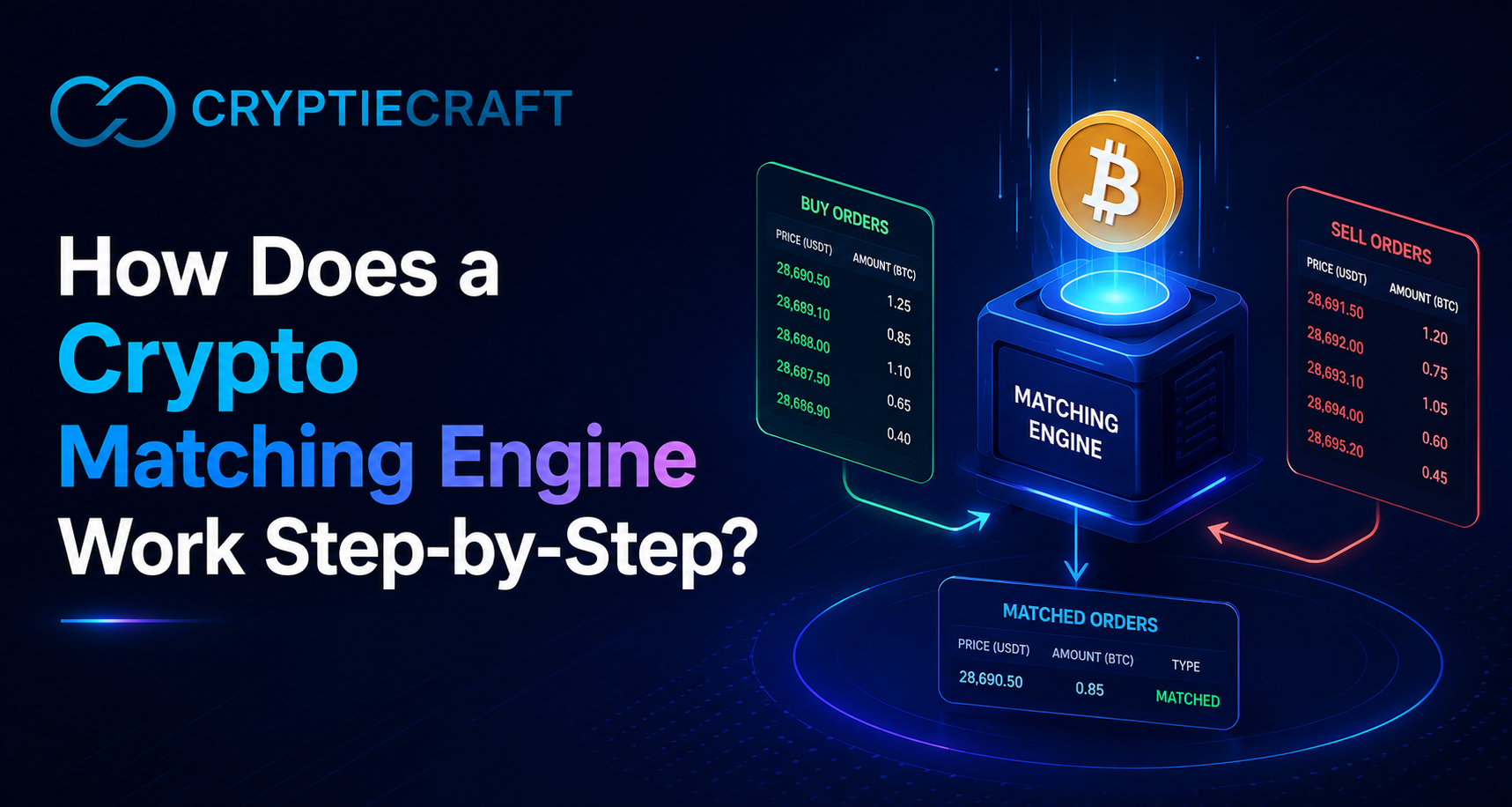
Every single trade on a crypto exchange, whether it is a $10 buy order or a $10 million institutional sell, passes through one piece of technology that most traders never think about. That piece is the matching engine.
An order matching engine in crypto exchange platforms is the silent operator behind every filled order, every price update, and every candle on the chart. Without it, an exchange is just a website with numbers. With it, an exchange becomes a real, functioning marketplace.
In this guide, we break down exactly how a crypto matching engine works, step by step, in plain language. No jargon overload. Just a clear walkthrough of what happens the moment you hit "Buy" or "Sell."
What Is a Crypto Matching Engine? (Quick Overview)
A crypto matching engine is the software system inside an exchange that pairs buy orders with sell orders. It looks at everyone who wants to buy Bitcoin and everyone who wants to sell Bitcoin, then connects the two sides based on price and timing.
Think of it like a very fast, very fair referee. It does not care who you are. It only cares about price and who arrived first. That is what makes trading on an exchange feel instant, even when thousands of orders are hitting the system every second.
At its core, the matching engine answers one simple question, over and over, thousands of times per second: does a buyer's price and a seller's price agree? If yes, a trade happens.
Key Components of a Matching Engine
Before we walk through the step-by-step process, it helps to know the building blocks that make a matching engine work.
Order Book (Buy and Sell Orders)
The order book is a live list of every open buy and sell order on the exchange. Buy orders sit on one side, sell orders on the other, and both are ranked by price.
Matching Algorithm
This is the logic that decides which orders get paired first. Most engines use price-time priority, meaning the best price wins, and if two orders share the same price, the one placed earlier wins.
Trade Execution System
Once a match is found, this system locks in the trade, updates both accounts, and records the transaction.
Liquidity and Market Depth
Liquidity refers to how many buy and sell orders are sitting in the order book at any given moment. Deeper liquidity means tighter spreads and smoother trade execution.
Types of Orders in Crypto Trading
Not all orders behave the same way inside a matching engine. Here are the main types you will run into.
Market Orders
A market order buys or sells immediately at the best available price. Speed over price.
Limit Orders
A limit order only executes at a price you set or better. Price over speed.
Stop Orders
A stop order sits inactive until the market hits a trigger price, then it converts into a market or limit order.
Maker vs Taker Orders
A maker order adds liquidity to the order book because it does not execute right away. A taker order removes liquidity because it matches instantly against an existing order. This distinction also affects trading fees on most exchanges.
Step-by-Step: How a Crypto Matching Engine Works
Here is the full journey an order takes, from the second you click submit to the second your trade shows up in your history.
Step 1: User Places an Order
It starts with you. You choose a trading pair, set your price and amount, and submit either a buy or sell request. This request instantly travels to the exchange's backend systems.
Step 2: Order Validation and Risk Checks
Before your order ever touches the order book, the system runs it through validation. It checks your account balance, confirms you are not violating any compliance rules, and screens for suspicious or fraudulent activity. Orders that fail these checks are rejected before they can affect the market.
Step 3: Order Added to the Order Book
Once validated, your order joins the order book. It gets sorted alongside every other open order, ranked by price first and then by the time it arrived. This sorting is what keeps the market fair and predictable.
Step 4: Matching Algorithm Finds a Match
Now the matching algorithm goes to work. In most crypto exchanges, this follows price-time priority, also called FIFO, which stands for First In, First Out. The engine scans the order book looking for a buy price and sell price that overlap. When it finds one, a match is triggered.
Step 5: Trade Execution
Once matched, the trade executes almost instantly. Ownership of the asset transfers, balances update on both sides, and the transaction is locked into the system. On a well-built engine, this entire step happens in milliseconds.
Step 6: Trade Confirmation
Both parties receive confirmation that the trade went through. This shows up in your order history along with the execution price, amount, and timestamp.
Step 7: Order Book Updates in Real-Time
Finally, the order book refreshes. Filled orders disappear, partially filled orders adjust their remaining size, and the live price chart updates to reflect the latest trade. This entire loop repeats continuously, thousands of times a minute on active exchanges.
Matching Algorithms Explained
Not every exchange uses the same matching logic. Here are the main models used across crypto exchange development.
FIFO (First In, First Out)
The most common model. Orders at the same price are filled in the order they were placed. Simple, transparent, and widely trusted.
Pro-Rata Matching
Instead of time priority, orders are filled proportionally based on their size relative to other orders at the same price. This model is more common in derivatives and high-frequency markets.
Hybrid Models
Some exchanges combine FIFO and pro-rata, using different rules for different order types or market conditions to balance fairness with liquidity incentives.
What Happens When Orders Don't Match?
Not every order fills immediately, and that is normal.
Pending Orders
If your limit order price is not yet available in the market, it sits in the order book as pending until a matching price appears.
Partial Fills
Sometimes only part of your order gets matched, especially with large orders. The unfilled portion stays open until it is completed or canceled.
Order Cancellation
You can cancel an unfilled or partially filled order at any time before it fully executes, pulling it out of the order book entirely.
Factors That Affect Matching Speed
Latency
The physical and network distance between the user, the server, and the matching engine affects how fast an order is processed.
Liquidity
Thin order books with few participants mean fewer matching opportunities and wider price gaps between trades.
Engine Performance
The underlying architecture, including how the engine is coded and hosted, determines how many orders it can process per second without lag or downtime.
Centralized vs Decentralized Matching Engines
Centralized Matching Engines
Run on the exchange's own servers, offering extremely high speed and deep liquidity, but requiring users to trust the platform with custody of funds during trading.
Decentralized Matching Engines
Operate on-chain or through smart contracts, giving users more control and transparency, though often at the cost of slower execution and thinner liquidity compared to centralized systems.
Each model has its place. Centralized engines dominate high-volume trading, while decentralized engines appeal to users who prioritize self-custody and transparency.
How Matching Engines Ensure Fair Trading
A well-designed matching engine is what keeps a market honest. It enforces strict price-time rules so no single trader gets special treatment. It also drives price discovery, meaning the constant matching of buy and sell orders is literally what determines an asset's market price at any given second. This transparency and consistency is what builds long-term trust in an exchange.
Common Challenges in Matching Engines
Slippage
When the market moves between the time you place an order and the time it executes, you may get a slightly different price than expected. This is more common with market orders during fast-moving conditions.
High Volatility
Sudden price swings can flood the order book with orders, testing how well an engine holds up under pressure.
System Overload
During major market events, order volume can spike dramatically. A poorly optimized matching engine can lag or even crash under this load, which is why performance and scalability are critical from day one. This is exactly where working with an experienced centralized exchange development company makes a measurable difference in how an exchange holds up during high-traffic trading events.
Future of Crypto Matching Engines (2026 and Beyond)
The next generation of matching engines is already taking shape. AI-powered matching is emerging to predict order flow and optimize execution paths in real time. Ultra-low latency systems are pushing execution times down into microseconds to meet the demands of algorithmic traders. And cross-exchange liquidity aggregation is starting to blur the lines between individual platforms, letting engines tap into liquidity pools beyond their own order books.
Conclusion
A crypto matching engine may run quietly in the background, but it is the single most important piece of technology inside any exchange. From the moment an order is placed to the moment it settles, this system is validating, sorting, matching, and executing trades with a level of speed and precision that makes modern crypto trading possible.
During major market events, order volume can spike dramatically. A poorly optimized matching engine can lag or even crash under this load, which is why performance and scalability are critical from day one. This is exactly where a properly engineered order matching engine in crypto exchange makes a measurable difference in how an exchange holds up during high-traffic trading events.
Understanding how it works does not just satisfy curiosity. It helps traders make smarter decisions about order types, timing, and platform choice, and it helps founders understand exactly what they are building when they invest in exchange infrastructure. At the end of the day, the matching engine is the heartbeat of every exchange, and getting it right is what separates a reliable trading platform from one that buckles under pressure.
#exchangeordermatchingengine #ordermatchingengine
Share On :
Tweet | LinkedIn | |