Businesses rely on efficient processes, accurate data, and connected systems to remain competitive. However, as organisations grow, outdated Enterprise Resource Planning (ERP) systems can become a barrier to progress. Disconnected applications, manual workflows, limited reporting capabilities, and rising maintenance costs can make it difficult for businesses to respond to changing market demands.
Businesses rely on efficient processes, accurate data, and connected systems to remain competitive. However, as organisations grow, outdated Enterprise Resource Planning (ERP) systems can become a barrier to progress. Disconnected applications, manual workflows, limited reporting capabilities, and rising maintenance costs can make it difficult for businesses to respond to changing market demands.
ERP transformation helps organisations modernise their existing systems, streamline operations, and build a technology foundation that supports long-term growth. Rather than simply upgrading software, successful ERP modernisation involves rethinking business processes, improving data management, and aligning technology investments with strategic objectives.
In this article, we explore the key strategies businesses can use to plan and implement ERP transformation successfully.
ERP transformation is the process of modernising an organisation's ERP environment to improve operational efficiency, data visibility, and business performance. It may involve upgrading an existing ERP platform, migrating to a cloud-based solution, integrating new technologies, or redesigning business processes.
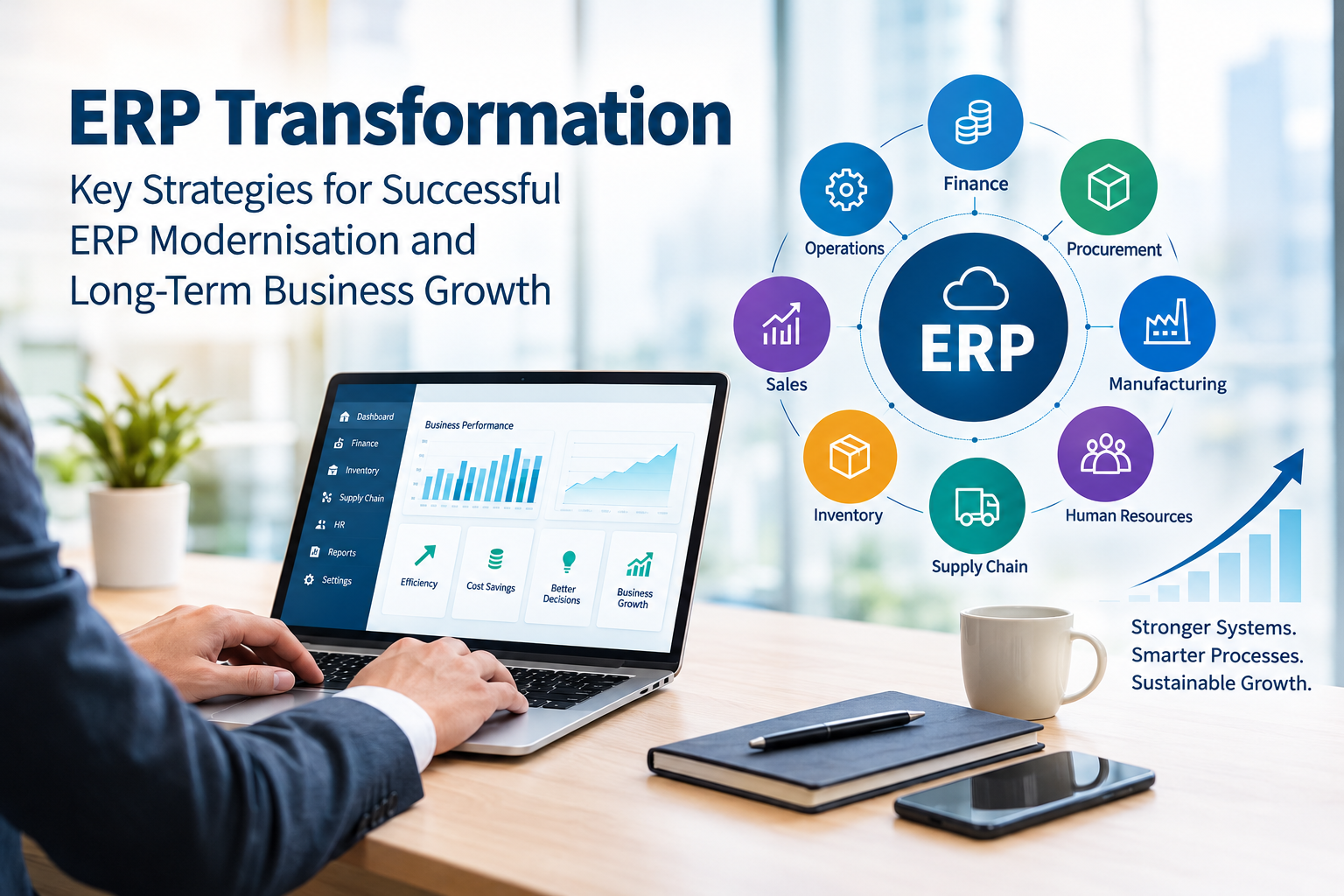
Traditional ERP systems often support essential functions such as finance, procurement, inventory, supply chain management, manufacturing, and human resources. However, older systems may struggle to meet modern requirements for real-time reporting, automation, scalability, and integration.
ERP modernisation helps businesses address these limitations while creating a more connected and flexible technology environment.
An outdated ERP system can affect multiple areas of business performance. Modernising the system allows organisations to address operational challenges and prepare for future requirements.
Manual data entry, duplicate processes, and disconnected applications can increase workloads and create avoidable errors. A modern ERP system can automate routine activities and connect workflows across departments.
For example, integrating procurement, inventory, and finance processes can help employees access consistent information without repeatedly entering the same data into different systems.
Business leaders need reliable information to understand performance and identify opportunities. Modern ERP platforms can consolidate data from different departments, making reporting and analysis more consistent.
With better access to operational and financial information, decision-makers can evaluate costs, monitor performance, and respond to potential problems more effectively.
As businesses expand into new markets, introduce products, or increase production, their technology systems must support additional complexity.
ERP modernisation can help organisations improve system flexibility, integrate new applications, and accommodate changing business requirements without relying on disconnected legacy tools.
When departments operate separate systems, information may become fragmented. A modern ERP environment can connect finance, operations, sales, procurement, and supply chain activities.
This creates a more consistent view of business performance and helps teams coordinate their work more effectively.
A successful ERP transformation requires more than selecting a new platform. Businesses need a structured approach that considers operational requirements, employee needs, technology capabilities, and long-term objectives.
Before starting an ERP project, identify the business challenges the transformation should address.
These objectives might include reducing manual work, improving inventory accuracy, shortening financial reporting cycles, strengthening supply chain visibility, or supporting expansion into new markets.
Clear objectives help organisations evaluate potential solutions and prioritise the features that matter most.
For example, a manufacturing company experiencing frequent inventory discrepancies may prioritise real-time stock visibility and production planning rather than implementing every available ERP feature at once.
A detailed assessment of the current ERP environment helps identify system limitations, integration issues, outdated workflows, and unnecessary complexity.
Businesses should examine how departments use existing systems, where data is duplicated, and which processes create operational delays.
This assessment also helps determine whether the organisation should upgrade its current platform, migrate to a different ERP solution, or redesign specific processes.
Documenting existing workflows before implementation makes it easier to identify improvements and avoid transferring inefficient practices into the new environment.
There is no single ERP transformation approach that suits every organisation. The right option depends on business size, system complexity, budget, existing infrastructure, and future requirements.
Common approaches include:
ERP upgrades: Updating the existing platform to access improved capabilities and maintain support.
Cloud ERP migration: Moving ERP workloads to a cloud-based environment to support accessibility, flexibility, and scalability.
ERP replacement: Implementing a new platform when the existing system no longer meets business requirements.
Phased modernisation: Updating selected modules or processes gradually to manage implementation risks.
Businesses should evaluate each option based on total cost, integration requirements, security, customisation needs, and expected business value.
Data is one of the most important components of an ERP transformation project. Inaccurate, duplicated, or incomplete data can undermine reporting and disrupt operations after implementation.
Before migration, organisations should identify critical data sources, remove unnecessary records, resolve inconsistencies, and establish clear data ownership.
Testing is equally important. Businesses should validate migrated records, reconcile financial information, and confirm that essential workflows operate correctly before the new system goes live.
A structured migration plan reduces the risk of operational disruption and helps employees trust the information available in the modernised system.
ERP transformation often changes how employees complete everyday tasks. Without adequate communication and training, even a technically successful implementation can face resistance.
Organisations should involve key stakeholders early, explain why the transformation is necessary, and provide role-specific training before launch.
Creating opportunities for employees to test the system and share feedback can also reveal usability issues before they affect daily operations.
Change management should continue after implementation, with support available as teams adjust to new processes.
Modern ERP environments can create opportunities to introduce automation, advanced analytics, and artificial intelligence.
Depending on the platform and business requirements, these capabilities may support invoice processing, demand forecasting, anomaly detection, inventory planning, and management reporting.
However, AI should not be introduced simply because it is available. Businesses should first identify suitable use cases, assess data readiness, and define how success will be measured.
For example, a distributor might explore demand forecasting to improve stock planning. The organisation should evaluate forecast accuracy and inventory outcomes before expanding the application to other functions.
ERP systems often contain sensitive financial, employee, supplier, and customer information. Modernisation projects must therefore include appropriate security controls and governance practices.
Businesses should define user access permissions, establish data ownership, review compliance requirements, and test security controls throughout implementation.
Clear project governance is also essential. Assigning responsibilities, monitoring milestones, and maintaining a process for managing changes helps keep the transformation aligned with business priorities.
Even well-planned ERP projects can encounter difficulties. Understanding common challenges helps businesses prepare practical solutions.
Scope expansion: Adding too many requirements during implementation can increase costs and delay delivery. Establish clear priorities and assess changes against agreed business objectives.
Integration complexity: Connecting the ERP platform with existing applications may require additional planning and testing. Document integration requirements early and validate critical data flows.
Data migration errors: Poor data quality can create reporting inconsistencies and operational problems. Conduct data cleansing, migration testing, and reconciliation before launch.
Employee resistance: Employees may be uncomfortable with unfamiliar processes. Provide regular communication, hands-on training, and ongoing support.
Unclear success measures: Without measurable objectives, it can be difficult to determine whether transformation has delivered value. Establish performance indicators before implementation and review them regularly.
Addressing these challenges early can help businesses control project risks and improve adoption.
ERP modernisation should deliver measurable improvements rather than simply replace an older system. Organisations should establish key performance indicators (KPIs) that reflect their business goals.
Relevant measures may include:
Time required to close monthly financial accounts.
Inventory accuracy and stock turnover.
Order processing and fulfilment times.
Frequency of manual data entry and process errors.
System availability and user adoption.
Total ERP operating and maintenance costs.
Accuracy and timeliness of management reports.
Businesses should record baseline performance before implementation and compare results after launch. Regular reviews can identify areas where additional training, configuration changes, or process improvements are required.
ERP transformation is an opportunity for businesses to improve operational efficiency, strengthen data visibility, and build a more adaptable technology environment. However, long-term success depends on more than implementing a modern platform.
Organisations need clear business objectives, a realistic modernisation roadmap, reliable data, effective change management, and measurable performance indicators. By addressing these areas, businesses can reduce implementation risks and ensure their ERP investments support meaningful business outcomes.
With the right strategy and ongoing optimisation, ERP modernisation can help organisations respond to changing market requirements, improve collaboration across departments, and establish a stronger foundation for long-term business growth.
ERP transformation is the process of modernising ERP systems, business processes, and technology infrastructure to improve efficiency, data visibility, and alignment with business objectives.
Key benefits can include improved operational efficiency, better reporting, stronger integration, reduced manual work, improved scalability, and more informed decision-making.
The timeline depends on the organisation's size, system complexity, data quality, integration requirements, and implementation approach. Smaller projects may take months, while complex enterprise transformations can take considerably longer.
Common challenges include poor data quality, integration complexity, expanding project scope, employee resistance, security concerns, and insufficient planning.
Businesses should monitor performance indicators, provide ongoing employee training, maintain strong security and governance, review system performance, and continuously improve processes as business needs evolve.