Latest Updates Click Here


Importance of Testing and Certification for Mechanical Couplers
India’s construction industry is evolving rapidly, driven by large-scale infrastructure projects, high-rise developments, metro rail networks, bridges, flyovers, and industrial structures. With increasing emphasis on safety, durability, and speed of construction, mechanical rebar couplers have emerged as a reliable alternative to traditional rebar lapping. However, the effectiveness of mechanical couplers depends heavily on proper testing and certification. In a country like India, where structural safety is non-negotiable, testing and certification play a crucial role in ensuring performance, compliance, and long-term reliability.
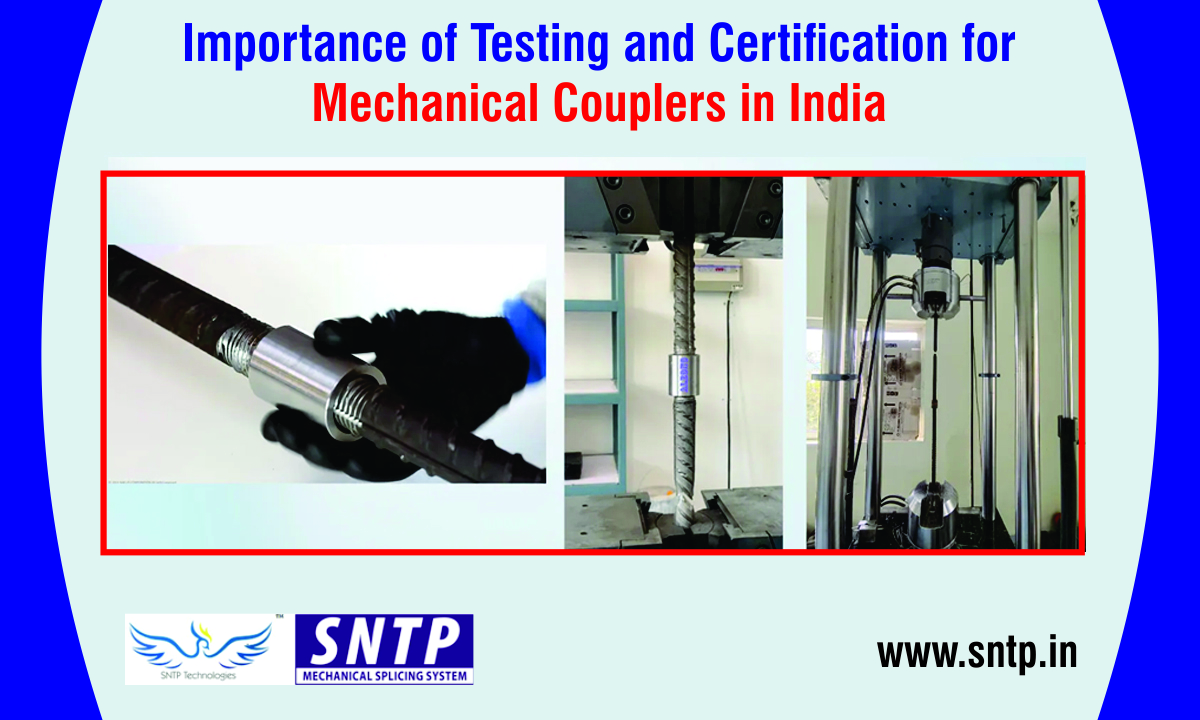
India’s construction industry is evolving rapidly, driven by large-scale infrastructure projects, high-rise developments, metro rail networks, bridges, flyovers, and industrial structures. With increasing emphasis on safety, durability, and speed of construction, mechanical rebar couplers have emerged as a reliable alternative to traditional rebar lapping. However, the effectiveness of mechanical couplers depends heavily on proper testing and certification. In a country like India, where structural safety is non-negotiable, testing and certification play a crucial role in ensuring performance, compliance, and long-term reliability.
Understanding Mechanical Couplers and Their Role
Mechanical couplers are devices used to join reinforcing steel bars end-to-end, allowing stress transfer without overlapping the rebars. They provide superior load transfer, reduce steel consumption, improve site efficiency, and enhance structural integrity. Mechanical couplers are widely used in high-rise buildings, seismic zones, precast construction, bridges, and heavy infrastructure projects.
Because couplers directly impact load-bearing capacity, even a minor defect or substandard product can compromise the entire structure. This makes testing and certification essential, not optional.
Why Testing Is Critical for Mechanical Couplers
Testing verifies whether a mechanical coupler can perform as intended under real-world conditions. Construction structures in India are exposed to diverse stresses such as seismic activity, temperature variations, heavy loads, and environmental factors. Proper testing ensures that the couplers can withstand these conditions safely.
Key reasons why testing is crucial include:
- Structural Safety
Mechanical couplers must achieve strength equal to or greater than the connected rebars. Testing ensures the coupler does not fail before the steel reinforcement, preventing catastrophic structural failures. - Load Transfer Verification
Tensile and cyclic load tests confirm that the coupler can transfer loads efficiently without slippage or deformation. - Consistency in Quality
Regular batch testing ensures uniformity in manufacturing, preventing weak or defective couplers from reaching construction sites. - Performance in Seismic Zones
India has several high seismic zones. Cyclic and fatigue testing ensures couplers perform reliably during earthquakes, where repeated stress cycles are common. - On-Site Reliability
Site conditions are often challenging. Testing validates that couplers function effectively even when installed under practical site constraints.
Common Tests Conducted on Mechanical Couplers
Certified mechanical couplers undergo a series of stringent tests, including:
- Tensile Strength Test – Ensures the coupler meets or exceeds the tensile strength of the connected rebar.
- Slip Test – Checks that there is no unacceptable movement under load.
- Fatigue Test – Simulates repeated loading conditions common in bridges and dynamic structures.
- Cyclic Load Test – Especially important for seismic applications.
- Dimensional and Thread Accuracy Test – Ensures precise fit and proper engagement of rebars.
These tests are usually conducted in NABL-accredited laboratories to maintain accuracy and credibility.
Importance of Certification in the Indian Context
Certification is official proof that a mechanical coupler complies with Indian and international standards. In India, certification is not just a quality benchmark but often a mandatory requirement for approval by consultants, government bodies, and project authorities.
Key benefits of certification include:
- Compliance with Indian Standards (IS Codes)
Certified couplers comply with relevant IS codes and guidelines, ensuring acceptance across government and private projects. - Approval from Consultants and Structural Engineers
Engineers rely on certified products to ensure design integrity. Certification builds confidence and simplifies approval processes. - Eligibility for Government and Mega Projects
Infrastructure projects such as metros, highways, airports, and smart cities require certified materials to meet strict safety norms. - Legal and Risk Protection
In case of disputes or structural issues, certified products provide documented proof of compliance, reducing liability risks. - Enhanced Market Credibility
Certification positions manufacturers as reliable and professional, strengthening brand reputation in a competitive market.
Role of Third-Party Testing and Certification Bodies
Independent testing and certification bodies play a vital role in maintaining transparency and trust. Third-party certification eliminates bias and ensures that results are accurate and unbiased. In India, most reputed projects demand third-party test reports from accredited labs before approving mechanical couplers.
This independent validation reassures developers, engineers, and authorities that the couplers meet required safety and performance benchmarks.
Impact on Construction Quality and Project Efficiency
Using tested and certified mechanical couplers significantly improves construction quality. Certified couplers reduce rework, minimize site errors, and ensure faster approvals. They also enhance productivity by enabling faster rebar connections without compromising safety.
Moreover, certified couplers contribute to sustainability by reducing steel wastage and improving material efficiency, aligning with India’s push toward greener construction practices.
Risks of Using Non-Tested or Non-Certified Couplers
Ignoring testing and certification can lead to severe consequences, such as:
- Structural failure or reduced load capacity
- Rejection of materials by consultants or authorities
- Project delays due to retesting or replacement
- Increased safety hazards for workers and occupants
- Legal liabilities and reputational damage
In cost-driven markets, opting for uncertified couplers may seem economical initially, but the long-term risks far outweigh the short-term savings.
Growing Importance with Advancing Construction Technologies
As India moves toward advanced construction methods like precast structures, modular construction, and high-rise developments, the reliance on mechanical couplers is increasing. With this growth, testing and certification will become even more critical to ensure compatibility with modern design requirements and evolving standards.
Manufacturers who invest in continuous testing, innovation, and certification will lead the future of reinforcement solutions in India.
Conclusion
Testing and certification are the backbone of safe and reliable use of Mechanical couplers in India. They ensure structural integrity, compliance with standards, acceptance by authorities, and long-term performance of reinforced concrete structures. In a rapidly growing construction landscape, choosing tested and certified mechanical couplers is not just a technical decision but a responsibility toward safety, quality, and sustainability.
For manufacturers, contractors, and developers alike, prioritizing certified mechanical couplers is a step toward building stronger, safer, and future-ready infrastructure for India.
Share On :
Tweet | LinkedIn | |