Latest Updates Click Here


Why Choose MatrixCare Software? Benefits, Features, Pricing & Alternat
Codatis provides software reviews, comparisons, pricing insights, and expert guides to help businesses choose the right software solutions.
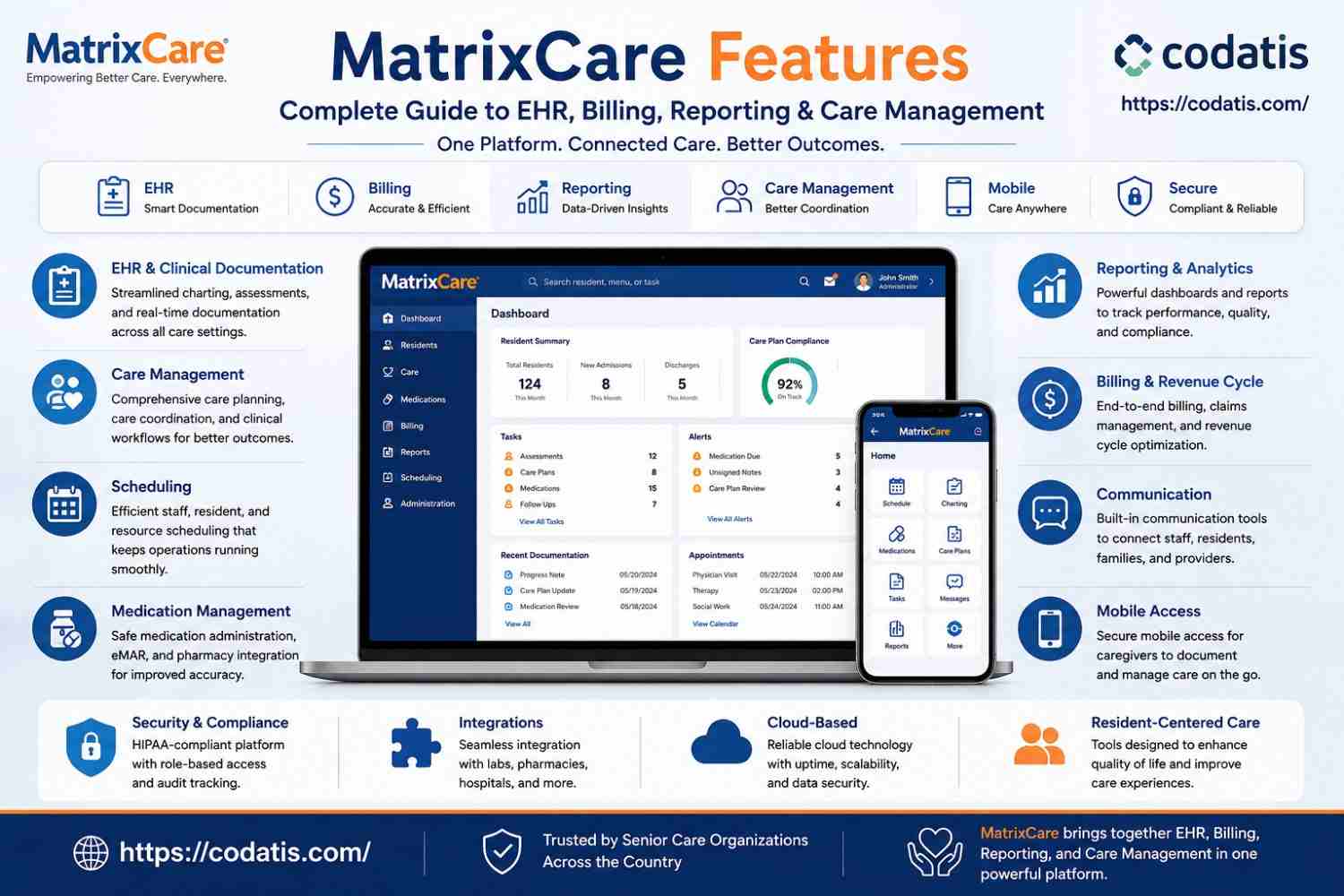
Choosing the right healthcare software can have a major impact on how efficiently a care organization operates. From clinical documentation and matrix care charting to billing, scheduling, reporting, and communication, the right electronic health record (EHR) should support both caregivers and administrators without creating unnecessary complexity.
So, what is MatrixCare, and why are healthcare organizations considering it in 2026? MatrixCare provides software solutions across several post-acute care settings, including home health, hospice, private duty, skilled nursing, senior living, and life plan communities. Its platform is designed to connect clinical and operational workflows while helping organizations manage information throughout the care journey.
For people searching for bridgemark matrix, MatrixCare EMR software, Matrix EMR features, or Matrix EMR pricing, this guide explains what the platform offers, its potential benefits, pricing considerations, reviews, and alternatives.
What Is MatrixCare Software?
MatrixCare is an EHR and healthcare management software platform focused primarily on home-based and long-term care organizations. Rather than being designed for only one healthcare environment, its product portfolio covers home health, hospice and palliative care, private duty, skilled nursing, senior living, and life plan communities.
This broad coverage can be valuable for organizations that operate across multiple care settings. Instead of maintaining completely separate systems for different parts of the organization, providers can evaluate whether a connected MatrixCare environment fits their operational model.
The platform also emphasizes interoperability and integrations. MatrixCare maintains a partner marketplace covering areas such as care coordination, claims management, analytics, admission management, pharmacy, payment services, and other healthcare technologies.
Key MatrixCare EMR Features
The most important Matrix EMR features depend on the care setting, but several capabilities are particularly relevant when evaluating the platform.
MatrixCare Charting and Point-of-Care Documentation
For home-based care providers, documentation needs to happen where care happens. MatrixCare's home health solution provides mobile point-of-care tools designed for clinical documentation, including information related to vitals, wound care, medication tracking, and plan-of-care updates. The platform supports both online and offline workflows, which can be useful for clinicians working in locations with inconsistent connectivity.
MatrixCare also provides speech-to-text functionality that can store dictated information directly in the EHR. For field clinicians, these tools can help reduce some of the administrative work associated with documenting visits.
Billing and Revenue Cycle Management
Healthcare software needs to support more than clinical records. Billing and revenue-cycle workflows are also important for maintaining an efficient operation.
MatrixCare's home health platform includes billing and revenue-cycle functionality, including claim generation, billing dashboards, denial management, eligibility processes, and compliance-related checks.
For skilled nursing organizations, MatrixCare also provides revenue-cycle management tools intended to support operational processes, reporting, and cash flow management.
Analytics and Reporting
Another reason organizations may consider MatrixCare is its analytics functionality. For skilled nursing, MatrixCare describes clinical dashboards and analytics that provide staff with information they can use to identify areas for clinical and operational improvement.
Its senior living solution also provides business insights covering areas such as census, occupancy, billing, budgeting, and operations.
This type of reporting can be particularly useful for administrators who need to make decisions based on current operational information rather than relying entirely on manually prepared reports.
Communication and Care Coordination
Care often involves nurses, physicians, patients, families, administrators, and external providers. MatrixCare supports communication and document-sharing workflows, including secure messaging, electronic signatures, document sharing, and video communication in supported solutions.
Its interoperability capabilities also include connections with healthcare networks such as CommonWell Health Alliance, Carequality, and SureScripts for supported home health workflows.
Benefits of Choosing MatrixCare
1. Supports Multiple Care Settings
One of MatrixCare's biggest advantages is the breadth of its product portfolio. Organizations can evaluate solutions for home health, hospice, private duty, skilled nursing, senior living, and life plan communities.
This makes the platform particularly relevant for organizations that operate across different parts of the post-acute care continuum.
2. Mobile-Friendly Clinical Workflows
Mobile documentation can be important for nurses and other professionals who spend much of their working day away from a traditional office. MatrixCare's home health solution is designed around mobile point-of-care workflows and supports offline documentation.
That can help field staff complete documentation closer to the point of care rather than having to rely exclusively on desktop systems.
3. Integrated Operational Tools
MatrixCare combines clinical and administrative capabilities across its different solutions. Depending on the product, organizations can access functionality related to documentation, billing, scheduling, reporting, communication, resident management, and other workflows.
The practical benefit is the possibility of reducing the need to manage disconnected systems for every operational function.
4. Interoperability and Integrations
Healthcare organizations rarely operate with one software system. MatrixCare provides a partner marketplace and integrations intended to connect its EHR with other healthcare technologies.
Before purchasing, however, organizations should confirm that the integrations they actually need are supported for their specific MatrixCare product and workflow.
Matrix EMR Pricing: What Should You Expect?
Matrix EMR pricing is one of the most common questions from prospective buyers, but there is no single universal price that applies to every MatrixCare customer.
Current third-party software sources describe MatrixCare pricing as custom or quote-based, meaning organizations generally need to contact the vendor for pricing based on their requirements.
That approach makes sense for a platform serving very different organizations. A small private-duty provider can have completely different requirements from a multi-location skilled nursing or senior living organization.
When requesting a quote, ask about:
-
Implementation and onboarding costs
-
Required modules
-
User or facility-related costs
-
Integrations
-
Training
-
Support
-
Contract terms
-
Additional services
Avoid choosing software based only on the initial subscription price. The total cost of ownership can also include implementation, training, data migration, integrations, and ongoing support.
Matrix EMR Reviews: What Do Users Say?
Matrix EMR reviews should be considered according to the specific MatrixCare product being reviewed. Different products serve different care environments, so a review from a skilled nursing facility may not accurately represent the experience of a home health agency.
Current Capterra data lists MatrixCare Home Health & Hospice at 4.2 out of 5 from 258 reviews. Its Skilled Nursing Facility product is separately listed at 4.3 out of 5 from 47 reviews.
Those ratings provide useful context, but they should not be the only factor in a purchasing decision. Pay attention to reviews discussing usability, implementation, customer support, documentation, reporting, integrations, and overall fit with your organization's workflow.
MatrixCare Demo and Login
A Matrix EMR demo is one of the best ways to determine whether the software actually fits your organization. MatrixCare currently invites prospective customers to schedule a conversation and see the platform in action.
During a demo, avoid simply asking the salesperson to show every feature. Instead, demonstrate your real workflow. Ask how a clinician completes a visit, how administrators monitor performance, how billing staff handle claims, and how information moves between connected systems.
For Matrix EMR login, existing customers should use their organization's authorized MatrixCare access method. MatrixCare's official support resources provide customer support and a MatrixCare Community login for existing users.
MatrixCare Alternatives
MatrixCare is not the only healthcare software option available. Depending on your care setting and requirements, organizations may also compare platforms such as PointClickCare, WellSky, Eldermark, myUnity, and StoriiCare.
Current Capterra comparisons list several of these products as alternatives for MatrixCare's skilled nursing solution.
The right alternative depends on what matters most to your organization. A provider focused primarily on home health may prioritize mobile charting, billing, EVV, interoperability, and clinical documentation. A skilled nursing organization may place more emphasis on resident management, clinical analytics, regulatory workflows, and reimbursement.
|
Evaluation Factor |
What to Compare |
|
Care setting |
Home health, hospice, SNF, senior living, private duty |
|
Documentation |
Mobile and point-of-care charting |
|
Billing |
Claims, eligibility, denials and RCM |
|
Integrations |
Existing healthcare and business systems |
|
Reporting |
Clinical, operational and financial analytics |
|
Usability |
Staff training and everyday workflow |
|
Support |
Implementation and ongoing assistance |
|
Pricing |
Subscription, modules and implementation costs |
Is MatrixCare the Right Choice for Your Organization?
MatrixCare can be a strong option for organizations looking for healthcare software that covers multiple post-acute care environments. Its range of solutions, mobile capabilities, analytics, billing tools, communication features, and interoperability make it worth evaluating for organizations with complex clinical and operational workflows.
However, no EHR is automatically the right choice for every organization. The best approach is to compare MatrixCare with alternatives using your actual requirements, not just a generic feature checklist.
Before making a decision, request a demo, define your must-have workflows, verify integrations, ask for a complete quote, and involve the people who will use the software every day.
Final Thoughts
For organizations researching bridgemark matrix, MatrixCare EMR software, MatrixCare charting, pricing, reviews, or alternatives, the key is to look beyond the software name and evaluate how the platform fits real-world healthcare operations.
MatrixCare offers a broad portfolio covering home health, hospice, private duty, skilled nursing, senior living, and life plan communities, with tools for documentation, billing, analytics, communication, and care management.
If you are comparing healthcare software, Codatis can be a useful resource for researching MatrixCare and other healthcare technology solutions, helping you understand features, pricing considerations, benefits, and alternatives before making an informed software decision.
FAQ’s
What is MatrixCare mainly used for?
MatrixCare is used for EHR and operational workflows across post-acute care settings, including home health, hospice, private duty, skilled nursing, senior living, and life plan communities.
Does MatrixCare support mobile charting?
Yes. MatrixCare's home health solution provides mobile point-of-care documentation and supports online and offline workflows.
How much does MatrixCare cost?
MatrixCare pricing is generally quote-based rather than published as one universal price. The final cost can depend on the organization, product, modules, implementation, and other requirements.
Does MatrixCare offer a demo?
Yes. MatrixCare's official website invites prospective customers to schedule a meeting to see its platform in action.
What are the main MatrixCare alternatives?
Depending on the care setting, alternatives can include PointClickCare, WellSky, Eldermark, myUnity, and StoriiCare. Organizations should compare them based on their specific workflows and requirements.
Share On :
Tweet | LinkedIn | |