Discover the essential guide to dental elevators! Learn how to choose the right one for your practice and enhance your dental procedures today.
Most of the extraction is already done by the time forceps reach the tooth.
Pick the wrong elevator and the socket fights you from start to finish. Pick the right one and the tooth often comes away with far less effort than you'd expect.
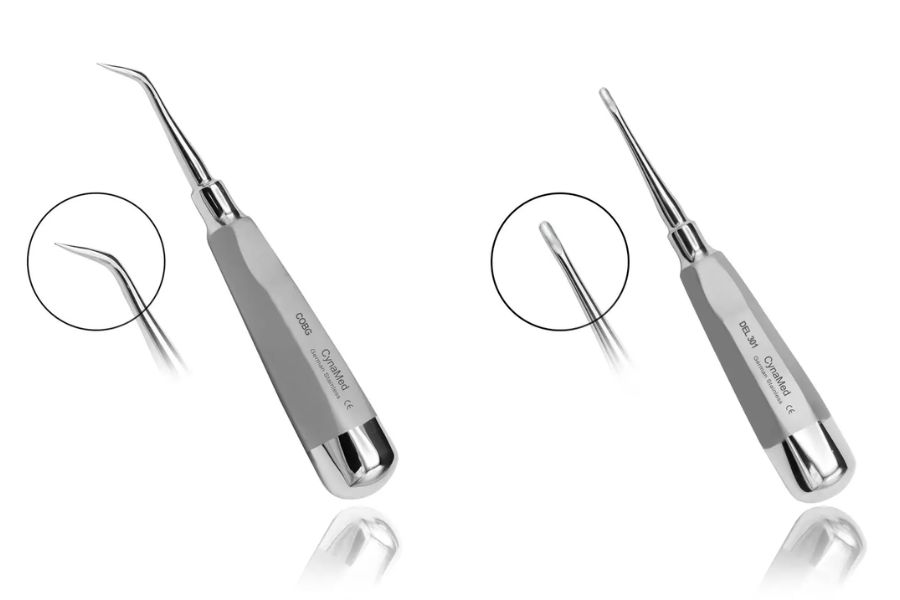
Push a dental elevators into the space between the tooth and bone, and it goes to work on the periodontal ligament, breaking the fibres one by one until the tooth finally gives way.
Now and then the tooth lifts out on its own. More often it just loosens enough for forceps to finish. Cynamed sells straight, curved, and angled elevators. Root curvature and the room you have to approach from decide which one to grab. A poor match leaves the tip pushing on soft tissue that had no reason to move.
Straight elevators cover most single-rooted extractions without much fuss. Curved blades earn their keep on roots that bend away from a straight approach — something a flat blade just can't follow cleanly. Then there are the luxating and winged designs, including Cynamed's luxating line in 1mm through 3.5mm, which ride along the root surface and sever the ligament with far less trauma to the bone. That matters a lot more when a socket needs to stay intact for an implant down the line.
A few specialty shapes round things out. Cogswell and Crane picks work narrow access points that bigger blades can't reach. Coupland sets and Cryer pairs — sold left and right — are built specifically for sectioning and root-splitting, techniques that come up often enough in oral surgery to justify keeping a set on hand.
Every elevator in our lineup is medical-grade stainless steel, which holds up through repeated autoclave cycles without pitting or dulling the way cheaper steel does. That's not a minor detail — a blade that dulls after a dozen sterilizations ends up costing more in replacements than a better one would have cost upfront.
Handle weight rarely gets a second thought until the wrist starts complaining. An unbalanced handle can leave a hand aching by the third or fourth patient of the day. A well-weighted one lets the pressure stay steady and controlled, and the grip lasts through a full clinic list.
A single elevator won’t cover both. For kids, go smaller and lighter. The roots haven’t finished forming, and muscling through does more harm than good. Adult molars play by different rules. Those roots go deep and hold on, so the instrument needs real stiffness to push against them. Anything that flexes under load is the wrong tool.
Does the shape match the root types you see most often in your own patient base? Is the steel grade actually built for the number of sterilization cycles your practice runs through in a week? And does the handle still feel balanced after you've held it for more than thirty seconds — not just on the first grip test?
Picking a dental elevator instruments boils down to three questions. Does the blade sit well against the root? Will the steel still be sharp after another few hundred autoclave cycles? Can your hand get through a whole case without cramping? Cynamed’s range includes straight, curved, and luxating elevators, with a few specialty shapes besides. For most general practices and oral surgery offices, that covers it.
FAQsAre Cynamed's dental elevators sterilizable?
They are. The stainless steel handles standard autoclave cycles, and it doesn't pit or lose its edge early.
Can one elevator work for both adults and children?
Not well. Kids need a smaller, lighter instrument. Adult molars call for a stiffer blade.
What makes a luxating elevator different?
It’s thinner and slides along the root, so less bone gets damaged.
How do I choose an elevator shape?
Root curvature and access angle usually decide it.