Learn how to prepare for the Cisco Meraki Solutions Specialist certification without feeling overwhelmed. Explore the Cisco 500-220 ECMS exam topics, build a realistic study plan, gain hands-on experience with Cisco Meraki Dashboard, and use practice tests to identify knowledge gaps and improve exam readiness.
It may be difficult for one to prepare for such exams when there are many things to learn. In the case of the Cisco Meraki Solutions Specialist, candidates are expected to understand cloud managed networking, wireless technologies, switching, security, and networking troubleshooting. All these are many things that could become overwhelming if one tries to learn all of them within a short time.
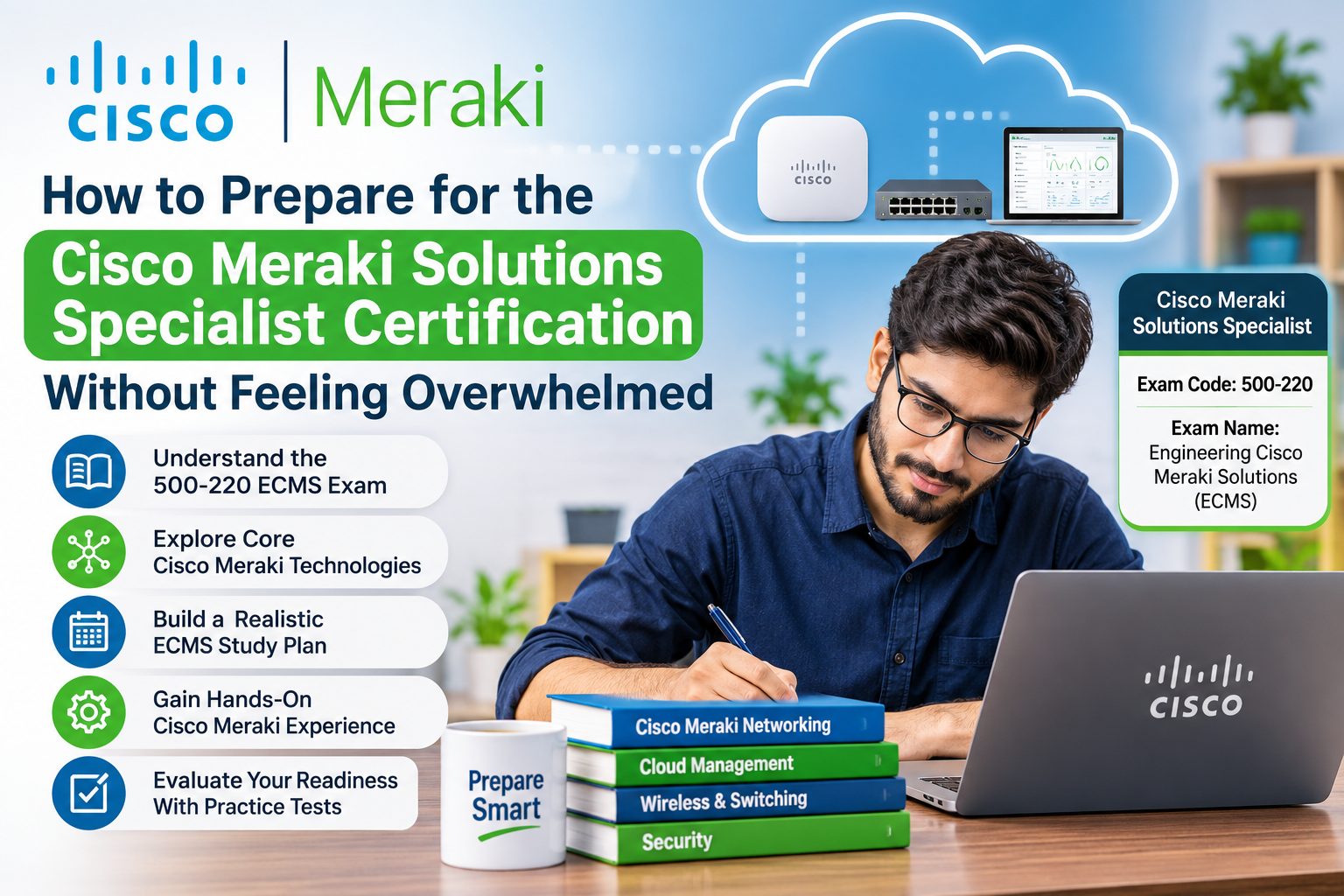
It is advisable to have a good approach towards the Cisco 500-220 exam. One should not hurry while trying to learn all the exam topics. The following are things one can do to get ready for this exam. They include knowing the requirements of the exam, studying the syllabus in sections, getting practical experience, and evaluation.
Before preparing for the test, spend some time learning about the Engineering Cisco Meraki Solutions exam and its significance. The code 500-220, commonly referred to as ECMS, is used for identifying the Cisco certification for which candidates should be prepared. The Engineering Cisco Meraki Solutions test measures the knowledge and skills needed to manage Cisco Meraki solutions. As such, it may be useful to professionals involved in the networking field who wish to learn how to use cloud managed infrastructures.
It is advisable to start with the Cisco-certified professional resources and review the topics of the exam. This will allow understanding better the knowledge areas one needs to be prepared and save one's time from learning about some unnecessary networking topics. Moreover, there are some concepts that you know and do not need to devote too much time to learning them while others require some additional effort to comprehend their meaning. For example, for a traditional networking person it is easy to understand the concepts of switching while he or she should spend more time understanding cloud management through the Cisco Meraki Dashboard.
In order to successfully prepare for ECMS certification, one should have good knowledge about Cisco Meraki technologies. Start from the basics of cloud-managed networking and find out how centralized management allows for easy administration of networks in different locations. Learn about the interaction between Meraki devices and the cloud dashboard as well as how the administrators work with the dashboard in order to control network operation, configurations, and issues that arise during monitoring. Understanding how devices interact with centralized management will help in connecting different technical notions rather than just memorizing them.
Then focus on such important areas of technologies as wireless networking, switching, security, and dashboard functions. Pay attention to how wireless access points allow for connecting, what kind of tasks switches perform, and how security allows for protecting networks. Do not forget to learn about common configuration and troubleshooting tasks as well. Instead of just learning technical terms, try to learn how the technology can be applied in a real business network. This approach will help in understanding difficult notions and applying knowledge while answering 500-220 exam questions.
A well-planned studying schedule will help avoid making the preparation for Cisco 500-220 exam overly stressful. Rather than trying to study all the material within one day, try to split the objectives of the exam into several small learning units. Allocate particular days for cloud management, wireless technologies, switching, security and troubleshooting. Set realistic goals per day depending on your prior knowledge of the material and time available. For instance, you may use one session for studying how to navigate the dashboard and another for learning about wireless configuration. Small goals will help you keep track of your progress without the necessity of accomplishing everything at once.
It is better to have consistency in your studying process than long hours without a clear goal. It is essential to create a weekly schedule which will provide time for reading, hands-on practices, revision and answering practice questions. When you finish studying a particular topic, make notes about key ideas and those parts which were unclear. Allocate extra time to learn difficult topics not to follow your initial schedule strictly. Remember that you need to regularly revise the studied topics.
It may be useful to read literature to learn networking basics, but practical experience helps to apply them. Knowledge of the Cisco Meraki Dashboard interface can be especially helpful because it represents a single place to control and monitor Meraki networking devices. Familiarize yourself with all the aspects of the dashboard and learn how administrators analyze network status, configure devices, check connected clients, and investigate performance problems. You will benefit from visiting a Meraki environment with an authorized demonstration or having access to the appropriate Meraki environment to explore dashboard capabilities and see how changes in settings influence network operation.
Practical learning should include such things as configuration tasks and troubleshooting techniques. Try to figure out how wireless access points are controlled, switching settings are configured, and network administrators investigate connectivity issues. Pay attention to the information available through monitoring tools and dashboard notifications. In case of any technical problem, try to determine possible reasons and the way of its identification. This will develop your problem-solving abilities instead of memorizing step-by-step instructions. Such practical sessions, even short ones, will give you more knowledge of Cisco Meraki networking solutions and help to remember technical details of the subject matter during the certification exam.
Practice exams will provide you with insight into the efficiency of your preparation. Taking an ECMS practice test will give you the chance to go over essential concepts, see how well you can apply them, and figure out what needs further review. Rather than using practice questions for memorization, take them as a means to test your grasp of networking concepts. Once you have answered a question incorrectly, revise the relevant topic and figure out what made your reasoning incorrect. Each practice session will be helpful in such a manner.
Additionally, you can use the mock exams to gauge your time management skills and general progress in preparation. Start with smaller batches of practice questions after studying each topic and take a wider practice exam after covering all of the major exam sections. Take note of your mistakes in order to return to these topics when revising them. Do not rely solely on your scores in practice to decide if you are ready for the exam; rather, think about whether you are able to explain the technical concepts and apply them in practice.
For additional preparation, explore ECMS practice resources: https://www.study4exam.com/cisco/500-220-ecms