Follow this software developer roadmap for 2026: skills, languages, projects, portfolio, and job steps, backed by U.S. data.
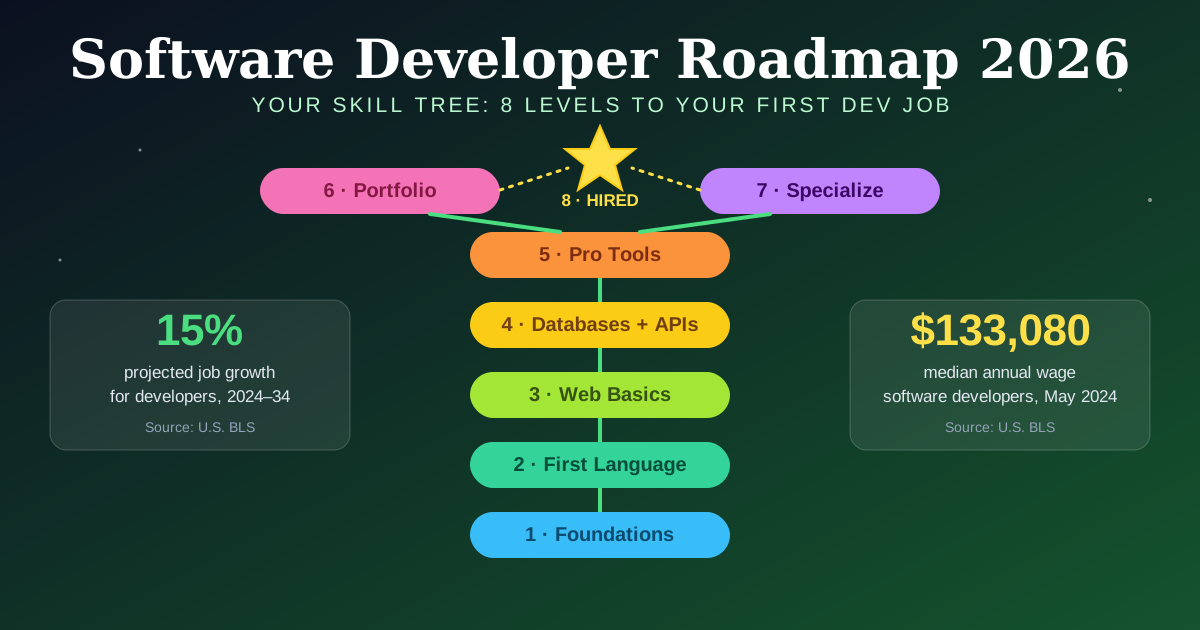
A good software developer roadmap works like a skill tree in a video game. You start at level one with basic moves. Each new level unlocks new powers. Skip a level, and the boss fight gets much harder. Follow the tree in order, and every step feels easier than the last.
At Untitle Tech, we work with developers every day. Some started with a computer science degree. Others switched careers at thirty. The ones who succeed share one habit. They follow a clear path and build real things along the way.
This guide gives you that path. You will see eight levels, a twelve-month plan, and the skills U.S. employers want. You will also see real data from the U.S. government and a major developer survey. Whether you live in Texas or Karachi, the steps are the same. For the bigger picture of how software gets built, read our software development guide alongside this one.
Start with the numbers. The U.S. Bureau of Labor Statistics (BLS) reported a median annual wage of $133,080 for software developers in May 2024. By comparison, the median for all U.S. occupations was $49,500. You can verify both figures on the BLS software developers page.
The outlook looks strong as well. The BLS projects 15 percent growth for software developers, quality assurance analysts, and testers from 2024 to 2034. That pace is much faster than the average for all jobs. In addition, the agency counted about 1.7 million software developer jobs in 2024.
However, one detail deserves attention. The BLS projects a 6 percent decline for computer programmers. It says some higher-skilled programming tasks will likely shift to software developers. The message is clear. Employers pay for people who solve problems and design systems, not only for people who type syntax.
Many beginners worry that AI will take their future jobs. The data offers a balanced view. In the 2025 Stack Overflow Developer Survey, 84 percent of respondents said they use or plan to use AI tools. At the same time, more developers distrusted the accuracy of those tools (46 percent) than trusted them (33 percent).
So AI is now a normal tool, like a code editor. Still, humans must verify, debug, and decide. Therefore, strong fundamentals matter more than ever. You cannot check code you do not understand.
Here is the full path at a glance. Each level builds on the last.
Now let us walk through each one.
Start with how computers think. Learn what a variable, a loop, and a function are. Understand how the internet works, from a browser request to a server reply. Then learn basic data structures, such as lists, dictionaries, and trees.
Do not rush this level. Many beginners skip to frameworks and then feel lost. A strong base makes every later skill faster.
Pick one language and stay with it. The Stack Overflow 2025 survey reported that JavaScript remained the most used language at 66 percent. HTML and CSS followed at 61.9 percent, SQL at 58.6 percent, and Python at 57.9 percent. The survey also noted that Python grew by 7 percentage points in a year.
Which should you pick? Use this simple rule:
The language matters less than the habit. Learn how to read errors, search for answers, and write clean code. Software development programming is a craft, and craft needs daily practice.
The web is the easiest place to see your work come alive. Learn HTML for structure, CSS for style, and JavaScript for behavior. Then learn how a page talks to a server. Study responsive design, because most U.S. users browse on phones.
Build a personal page first. After that, build a small interactive tool, such as a budget calculator. Each project teaches more than ten videos.
Almost every real product stores data. Learn SQL first. It remains one of the most used languages in the survey. Practice creating tables, joining them, and filtering results. Then learn how APIs work. An API is a menu that lets one program ask another for data.
Build a back end that saves and returns information. A simple notes app works well. Add user login to see how security enters the picture.
This level separates hobbyists from professionals. Learn Git for version control. Learn to write automated tests. Learn how code moves from your laptop to production. Our CI/CD pipeline guide explains that journey step by step.
Also learn to read other people's code. Real jobs involve far more reading than writing. Join an open-source project and fix a small bug. The experience teaches teamwork and patience.
Employers hire proof, not promises. Build three solid projects and show them well. Each project needs a live link, a clean code repository, and a short write-up. Explain the problem, your choices, and what you would improve.
Pick projects that solve real problems. Ideas include a local business booking tool, a habit tracker, or a small store with payments. Real users give real feedback. As a result, your skills grow faster.
Now choose a lane. Every lane maps to real services that companies buy.
You do not need to choose forever. Try a small project in two lanes. Then follow the one that excites you.
Finally, aim for the job. Write a clear resume with links to your best work. Keep it to one page. Update your profile on professional networks. Then apply in small batches, and track every application in a simple sheet.
Prepare for interviews in three parts. First, practice coding problems. Second, practice explaining your projects aloud. Third, prepare questions about the team and its process. Employers often ask how you handle bugs, deadlines, and feedback.
The BLS lists a bachelor's degree in computer and information technology or a related field as the typical entry path. However, a strong portfolio can open doors for self-taught developers, especially at startups. Aim for the path that fits your life.
A plan turns hope into a schedule. Here is a realistic path for someone studying part-time.
Study at least ten hours a week. Consistency beats intensity. Thirty focused minutes every day beat one exhausting weekend.
Technical skills open the door. Professional skills keep you inside. Both matter.
Process knowledge also helps. Learn the software development life cycle phases so you understand where your work fits. In addition, study Agile vs. Waterfall because interviewers often ask about team methods.
Stories make roadmaps real. Sara is an illustrative example, not a real person. She worked in retail in Phoenix and wanted a change.
Sara studied for ten hours each week. She learned Python, then SQL. After six months, she built a small inventory tool for a local shop. The owner used it daily and sent her feedback. That feedback taught her more than any course.
Sara then added tests and a simple pipeline. She published three projects and wrote a short story for each. In month eleven, a small company interviewed her. They did not ask about a degree. Instead, they asked about her inventory tool.
The lesson is simple. Real projects create real confidence. Every level of the skill tree becomes proof you can show.
Avoid these common traps:
Some readers want a career. Others want to hire a team instead. Both paths need the same understanding. If you plan to build a product, start with tech consulting services to test your idea. After launch, an SEO service helps your pages reach American searchers.
At Untitle Tech, one team covers strategy, design, development, search visibility, and support. Fewer handoffs mean faster and calmer projects.
A software developer roadmap is not about speed. It is about order. First, learn the foundations. Next, master one language. Then build for the web, add databases, and learn professional tools. After that, prove your skills with projects, choose a specialty, and hunt for your first role.
The U.S. data shows steady demand for developers who solve real problems. AI will keep changing the tools. Strong fundamentals will keep you valuable. If you are building a product and need experienced hands, Untitle Tech can help you plan, build, and support it. Contact our team today and tell us what you want to create.
Most part-time learners need about nine to eighteen months to reach job-ready level. Full-time study can shorten that. The time depends on your starting point, your weekly hours, and the quality of your projects. Consistent practice matters more than speed.
Choose JavaScript for web development or Python for data, automation, and back-end work. Both rank among the most used languages in the 2025 Stack Overflow survey. Pick one and stay with it for at least three months. Concepts transfer easily to other languages later.
Not always. The BLS lists a bachelor's degree as the typical entry-level education. However, many employers, especially startups, also value a strong portfolio and clear skills. A degree helps with some employers, while real projects help with almost all of them.
You need one core language, SQL, Git, testing, and basic security. You also need clear communication and teamwork. In addition, learn to use AI tools carefully and verify their output. Employers trust developers who understand the code they ship.
The BLS projects 15 percent growth for software developers from 2024 to 2034. AI tools are now common, but many developers distrust their accuracy, according to the 2025 Stack Overflow survey. Humans still design, verify, and own the result. Developers who use AI wisely will have an edge.