Comparing a small business loan Oakville owners can use with a line of credit? See costs, best uses, a checklist and how to choose the right fit.
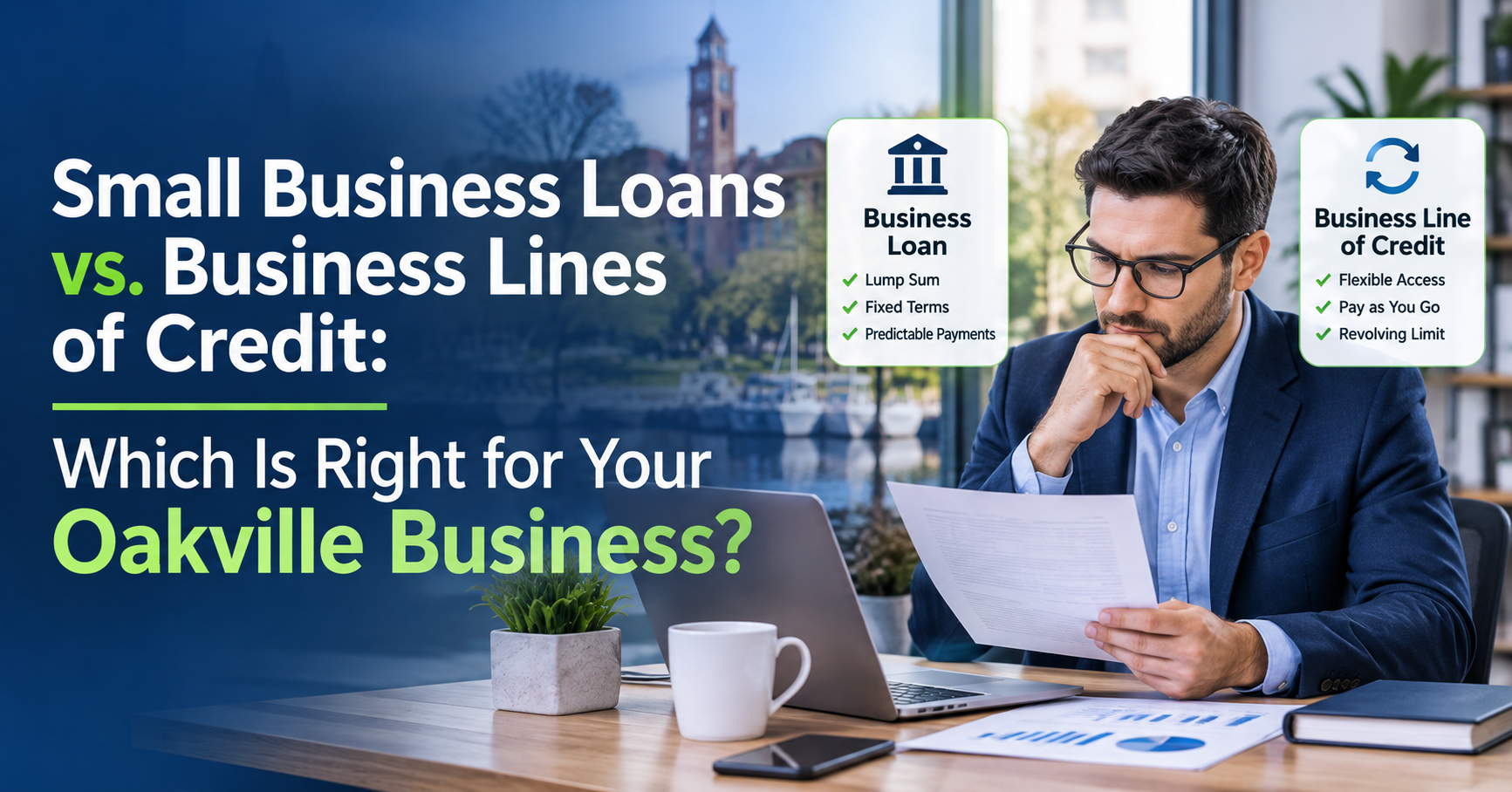
Most business owners hit a moment when the bank account needs some help. A work van gives out. A lease needs a renovation. A big client is 60 days late on an invoice. So you start looking for a small business loan Oakville lenders will approve, and then a second question shows up: should it be a loan or a line of credit? They sound alike, but they solve different problems. Small businesses employ about 5.8 million Canadians, or 46.6% of the private workforce, so this is a decision many owners face. Here is how to make it with confidence.
Before you compare rates on any small business loan Oakville lenders offer, ask one plain question: what will this money do?
If you are buying something that lasts, like a truck, an oven or a shop renovation, a loan usually fits. If you are covering timing gaps, like paying staff before customers pay you, a line of credit usually fits. Many owners use both.
It also helps to see the bigger picture. Federal data shows that between 2017 and 2021, about 103,001 small businesses opened each year in Canada, while about 94,197 closed. That churn is a good reminder to borrow carefully and give every dollar a clear job.
A term loan pays you one lump sum. You repay it on a fixed schedule, usually monthly, with interest, until the balance hits zero. The rate can be fixed or variable, and the lender may ask for security such as equipment or property.
A small business loan Oakville owners choose is usually tied to one specific purchase. That keeps the borrowing focused and easy to track.
Buying or upgrading equipment and vehicles
Renovating a leased or owned space
Opening a second location
Buying out a partner or purchasing another business
The big plus is predictability. You know your payment, your term and your end date, so budgeting is simple. An Oakville small business loan also tends to go higher in amount than a line of credit.
There are trade-offs. You pay interest on the whole amount from day one, even if you do not need all of it yet. The money is meant for a set purpose, so there is less room to change plans. Approval can also take longer, because the lender looks closely at the purchase, your financials and any collateral.
A line of credit is a revolving limit. The lender approves a maximum amount. You draw what you need and pay interest only on what you have used. When you pay it back, the room opens up again.
Think of it as a cushion for cash flow, not a tool for big purchases.
Covering payroll while you wait for invoices to be paid
Buying stock before a busy season
Getting through slow months
Handling short, unexpected costs
You borrow in small pieces and avoid paying interest on money you are not using. Rates are often variable, so your cost can move up or down with the market.
The risk is habit. A line that is always maxed out is a sign of a deeper cash flow gap, and borrowing more will not fix it. Limits are also usually smaller than term loans, and a lender can review or change the line over time.
|
Feature |
Term loan |
Line of credit |
|
How you get the money |
One lump sum |
Draw as needed |
|
Interest charged on |
The full amount borrowed |
Only the amount drawn |
|
Repayment |
Fixed schedule |
Flexible, interest on the balance |
|
Best for |
Equipment, expansion, renovations |
Cash flow, stock, short gaps |
|
Typical size |
Larger |
Usually smaller |
|
Rate type |
Fixed or variable |
Often variable |
|
Main risk |
Paying interest on unused funds |
Leaning on it as permanent funding |
Two Oakville Businesses, Two Different Answers
These examples are illustrations, not quotes. Your real rates depend on your file and the market.
An Oakville landscaping company needs a $60,000 work truck. This is a classic small business loan Oakville use case. At an assumed 9% over five years, the payment would be about $1,245 a month. The cost is known, the payment fits the budget, and the truck earns money while the loan shrinks.
A downtown Oakville shop has to buy holiday stock in September, but most of that revenue does not arrive until December. A line of credit fits. If the owner draws $20,000 for two months at an assumed 10%, the interest is roughly $333. Once holiday sales come in, the balance is paid back and the credit is ready for next time.
In both cases, the product matches the timing of the need. That match matters more than shaving a fraction of a point off the rate.
If a bank has said no, or your business is fairly new, ask about the Canada Small Business Financing Program. It is delivered by banks and credit unions with the federal government sharing the risk, so lenders can feel more comfortable saying yes. You apply through the lender, not the government.
Most start-ups and established for-profit, not-for-profit and charitable businesses with gross revenues of $10 million or less can apply. Here are the headline numbers from the program's own guidance:
|
Detail |
What the program allows |
|
Maximum per borrower |
$1.15 million total |
|
Term loans |
Up to $1 million |
|
Lines of credit |
Up to $150,000, for working capital |
|
Rate cap, variable term loan |
Lender's prime rate plus 3% |
|
Rate cap, line of credit |
Prime plus 5% |
|
Line of credit coverage |
Up to 5 years, then it can be renewed or converted |
Program rules get reviewed from time to time, so confirm the current limits with your lender before you plan around them.
For anyone comparing an Oakville small business loan from a bank, a credit union or a broker, this program can widen your options.
Whether you want an Oakville small business loan or a line of credit, lenders tend to ask the same few things. They want steady cash flow that can cover the payments. They look at how long you have been operating and at the credit history of the business and its owners. They check what you could offer as security, and they want a clear picture of how the money will be used.
A tidy set of financials and a short, honest plan go a long way. If your numbers are thin, a smaller request or a different product may fit better than the one you first had in mind.
Write down what the money is for and when you will repay it
Decide if the need is one-time or keeps coming back
Gather your last two years of financial statements and tax returns
Check your personal and business credit reports for mistakes
List any assets you could offer as security
Work out the payment you could handle in your slowest month
Ask each lender for the full cost, fees included, in writing
Confirm whether the rate is fixed or variable
Ask about penalties for paying early
Compare at least two or three lenders
Shopping lenders one by one takes time. For a small business loan Oakville brokers can line up several offers in one place. OAK Financials, an Oakville brokerage serving Halton Region and the GTA, compares options from banks, credit unions and alternative lenders. Its services include small business loans, commercial mortgages and self-employed mortgages, and it operates in affiliation with Delta Mortgages Inc. (FSRA #13078).
Whoever you choose, ask how they are paid, ask for fees in writing, and check their licence with the provincial regulator.
Not always. It depends on your revenue, credit and time in business. Established companies with steady sales often find lines easier, while newer businesses sometimes qualify more readily for a secured term loan.
Yes. Many owners use a term loan for big purchases and a line of credit for daily cash flow. Lenders will look at your total debt, so make sure your cash flow can carry both.
It depends on the need. Equipment points to a term loan, and operating costs point to a line of credit. New businesses can also be eligible for the federal program above, so ask about it.
Look past the headline rate. Compare the total cost, fees, repayment flexibility, security required and how fast the funds are released.
There is no single best product, only the one that fits your situation. Use a term loan to pay for something that lasts. Use a line of credit to manage when money comes in and goes out. Before you sign any small business loan Oakville lenders put in front of you, write down the purpose, work out your worst-month payment and compare more than one lender.
If you would like a second opinion, you can learn more about small business loan Oakville options at OAK Financials. A clear plan will do more for your Oakville business than a rushed yes.